Category: Featured

Featured stories and must-read content from BodySlam.net.

  • Exclusive: WWE ID Talents Must Use Their WWE Names Going Forward

    Exclusive: WWE ID Talents Must Use Their WWE Names Going Forward

    No more indie names for WWE ID talents.

    Sources have revealed to Bodyslam.net that Independent Wrestlers who have been signed by WWE for a WWE ID contract will no longer be able to use their indie names. Going forward they will have to use their WWE ID names for all upcoming appearances.

    Current WWE ID talent and their indie names:

    Aricia Demia going by Anya Rune

    Notorious Mimi going by Sloane Jacobs

    Starboy Charlie going by Chazz Starboy Hall

    Jariel Rivera going by Santi Rivera

    Jimmy House going by CJ Valor

    Mike Cunningham is now going by Max Abrams

    (Please credit Bodyslam.net when using this news.)

  • Top 10 Greatest Rivalries and Feuds in Wrestling History

    Top 10 Greatest Rivalries and Feuds in Wrestling History

    There’s a reason people who “don’t even watch wrestling” know who Stone Cold Steve Austin is. Or why a match from 1987 still gets referenced in think pieces today. The best feuds in pro wrestling aren’t just about two guys fighting — they’re about conflict, identity, and the kind of storytelling that gets under your skin whether you want it to or not.

    These are the ten rivalries that did exactly that.


    10. Randy Savage vs. Ricky Steamboat

    WWF, 1986-1987

    Before anyone had figured out what a truly great wrestling match could look like, Randy Savage and Ricky Steamboat sat down and essentially invented it. The setup was simple and vicious: Savage drove Steamboat’s throat into the guardrail, then dropped a ring bell onto his larynx from the top rope, putting him out of action. From that moment on, the crowd wanted revenge in the worst way.

    What they got at WrestleMania III — in front of 93,173 fans packed into the Pontiac Silverdome in Michigan — was 14 minutes and 35 seconds of pure, breathless wrestling, complete with 22 pin attempts and almost no wasted movement. Steamboat won the Intercontinental title and stole the show from a card headlined by Hogan and Andre the Giant. Savage himself later said that everywhere he went, fans brought up this match above all others. Thirty-plus years later, they still do.

    9. Sami Zayn vs. Kevin Owens

    Independent Circuit / NXT / WWE, 2002–Present

    Most feuds have a beginning and an end. This one just keeps finding new chapters.

    Sami Zayn and Kevin Owens first fought each other in 2002 in IWS, a small Canadian indie promotion, and went on to tear apart PWG, Ring of Honor, NXT, and WWE across the next two decades. What makes it work is that it’s never just about the belt or the spot on the card — it’s about two people who genuinely know each other too well. The betrayals hit harder because the friendship was real. The reunions feel earned because you’ve watched them earn it.

    By the time they stumbled into an unlikely tag team championship run together — partly as a result of Zayn’s absurd infiltration of The Bloodline — the whole thing had taken on a dimension no writer could have planned. No modern feud has more history or more heart.

    8. Edge vs. John Cena

    WWE, 2006–2009

    Edge and Cena didn’t like each other, and it showed. Edge was the guy who would cash in a Money in the Bank briefcase at 2 in the morning on a wounded champion — which he literally did — while Cena was the company’s straight-laced golden boy who couldn’t be bought or bent. The contrast was perfect.

    What elevated this beyond a standard good-vs.-evil feud was that Edge was genuinely compelling as the villain, not just cartoonishly evil. He was smart, petty, and opportunistic in ways that felt real. Their TLC matches were some of the most brutal and athletic spectacles of the era, and the feud had enough twists and title changes to sustain multiple years without feeling tired. It’s a rivalry that holds up much better than people give it credit for.

    7. Ric Flair vs. Dusty Rhodes

    EVERYWHERE – NEVER ENDED REALLY

    Before WWE dominated everything, American wrestling was a patchwork of regional territories — and the NWA produced some of the most sustained, genuinely emotional feuds the business has ever seen. The crown jewel of that era was Ric Flair against Dusty Rhodes.

    The contrast couldn’t have been sharper. Flair was all private jets, designer robes, and championship gold — a man born to make you despise him. Dusty was the “American Dream,” a heavyset guy from the Carolinas who talked and fought for everyday working people. It was class warfare turned into pro wrestling, and arenas sold out for it night after night for over a decade. This feud is the reason the NWA still means something to people who weren’t even alive to see it.

    6. John Cena vs. CM Punk

    WWE, 2011–2013

    On June 27, 2011, CM Punk sat cross-legged at the top of the entrance ramp and delivered what became known as “the Pipe Bomb” — a promo that blurred the line between scripted television and genuine grievance so completely that even some media outlets weren’t sure what they’d just watched. Nothing in the promo was scripted by WWE writers. Punk was saying what he actually thought, with permission to say it on live TV, and it showed.

    Their match at Money in the Bank 2011 in Chicago — Punk’s hometown — was a five-star classic according to Dave Meltzer, the first WWE match to receive that rating since 1997. The atmosphere was unlike anything seen in years: 15,000 fans treating Cena like the villain and Punk like a returning hero. Punk won the title, walked out of the arena, and posed for photos on the street with his friends. For a moment, it felt like anything could happen in WWE. That feeling is rarer than it should be.

    5. Kane vs. The Undertaker

    WWF/WWE, 1997–2010

    This one hits home. I was at the age where I still thought wrestling was real. No feud in WWE history has a better origin story. For months in 1997, Paul Bearer — Undertaker’s long-time manager — hinted at a dark secret: that Undertaker had started a fire as a child that killed his parents and his younger brother Kane. Then, during the very first Hell in a Cell match at Badd Blood: In Your House in October 1997, the lights went out, the arena turned red, and out walked a 7-foot masked monster in red and black. Kane ripped the cell door clean off its hinges, stood face-to-face with his brother, and Tombstoned him — costing Undertaker the match.

    What followed was one of the most gothic, emotionally rich storylines WWE has ever produced. Undertaker initially refused to fight his own brother no matter what Kane did to provoke him — and Kane did plenty, including burning a casket with Undertaker inside it at the 1998 Royal Rumble. When they finally met at WrestleMania XIV, it took Undertaker three Tombstone Piledrivers to put Kane away. Their first Inferno match followed shortly after. Then a brief, uneasy alliance. Then betrayal again.

    The feud never truly ended — it just kept finding new reasons to restart, spanning more than a decade of feuds, tag title runs, Buried Alive matches, and Hell in a Cell rematches. The in-ring quality was inconsistent, but as a piece of long-form storytelling driven by two iconic characters and one of wrestling’s greatest managers in Paul Bearer, it has no equal. Kane’s debut alone is considered by many the greatest character introduction in wrestling history.

    4. Shawn Michaels vs. Bret Hart

    WWF, 1992–1997

    The real heat between these two made everything better and everything more volatile. Bret Hart and Shawn Michaels genuinely could not stand each other — their professional jealousy, their clashing personalities, their competing visions of what wrestling should be — and all of it ended up on screen whether it was meant to or not.

    What they produced together was extraordinary. Their 61 minute Iron Man Match at WrestleMania XII is still talked about today. And then came Montreal in November 1997, where Vince McMahon had the referee ring the bell while Bret was still locked in the Sharpshooter, costing him the title on his last night in WWE. It wasn’t a storyline. It actually happened. Bret didn’t know it was coming. The look on his face when he realized it was real is one of the most haunting images in wrestling history. No rivalry has ever ended quite so messily, or been quite so impossible to look away from

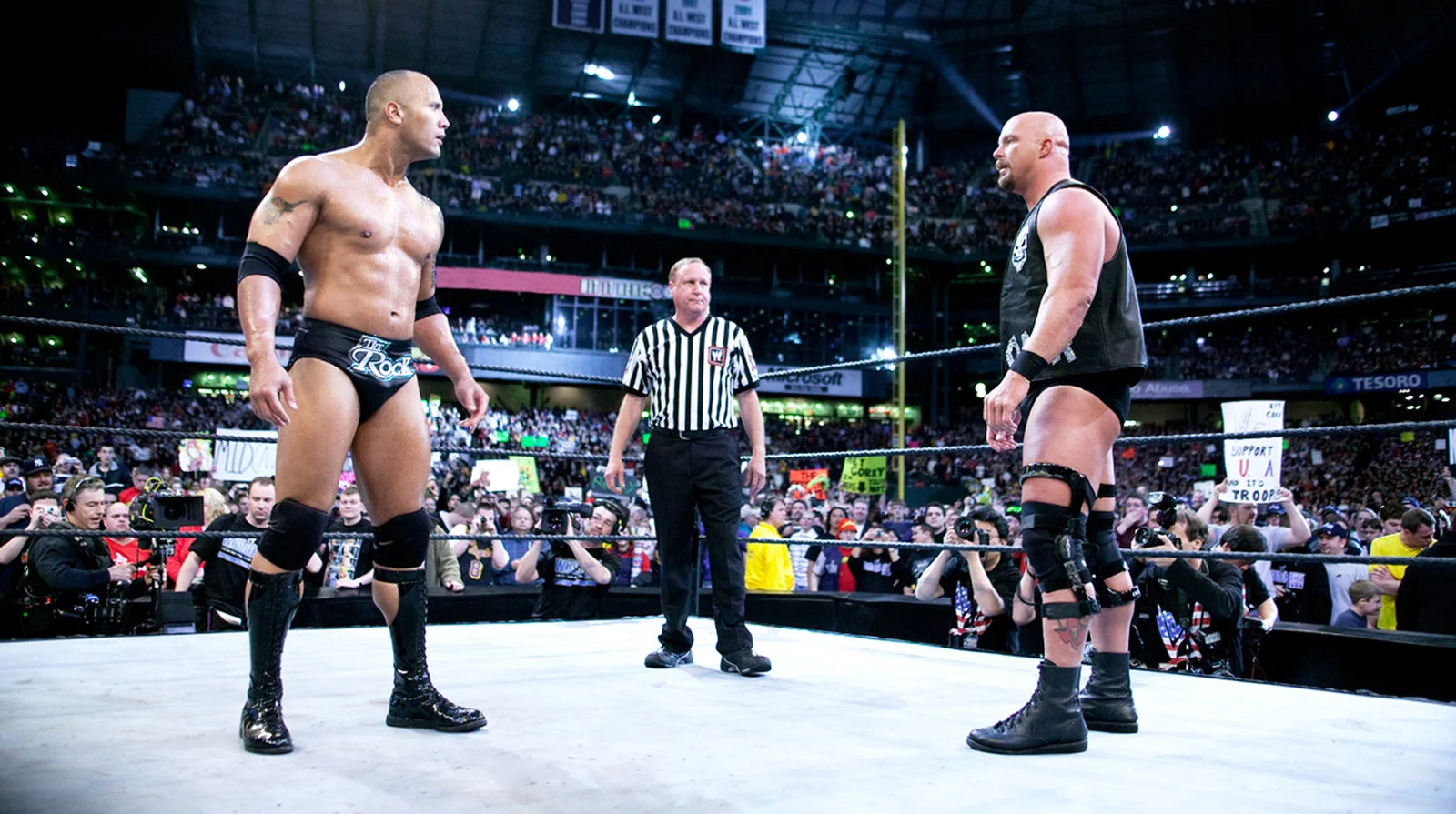
    3. The Rock vs. Steve Austin

    WWF, 1997–2003

    They headlined WrestleMania together three times — at XV, XVII, and XIX — and each match felt like the biggest possible version of itself. The Rock and Steve Austin had the kind of chemistry that makes everything look effortless: the timing, the crowd manipulation, the ability to take a moment and stretch it until the whole building was vibrating.

    Austin was the blue-collar brawler from Texas. The Rock was the arrogant, preening Hollywood star who happened to be one of the greatest talkers the business has ever produced. Together they carried the Attitude Era to its highest peaks and gave WWF the ammunition it needed to finally pull ahead of WCW in the ratings. Austin’s last match for 19 years was against The Rock at WrestleMania XIX in 2003. They could have phoned it in. They didn’t.

    2. Kenny Omega vs. Kazuchika Okada

    NJPW / AEW, 2017–Present

    This feud didn’t just produce great matches — it changed the wrestling business.

    Kenny Omega had just become the first foreigner to win New Japan’s prestigious G1 Climax tournament when he challenged Okada for the IWGP Heavyweight Championship at Wrestle Kingdom 11 in January 2017. What followed earned a record-breaking six-star rating from Wrestling Observer’s Dave Meltzer, who called it one of the greatest matches in the history of professional wrestling. Across four bouts in NJPW — accumulating more than 200 minutes of combined match time — the two men established a standard for in-ring work that genuinely had not existed before. New Japan’s subscriber numbers spiked after Wrestle Kingdom 11 alone. The buzz from this rivalry drew new audiences to wrestling worldwide and helped lay the creative groundwork for AEW’s founding. Their rematch at Dominion 6.9 in 2018 received seven stars from Meltzer — a number that felt impossible until it wasn’t.

    In terms of pure in-ring achievement, nothing in the 21st century comes close.

    1. Steve Austin vs. Vince McMahon

    WWF, 1997–2003

    It started on September 22, 1997, when Austin hit McMahon with a Stunner on Raw — a moment described as “previously unthinkable” because McMahon had simply been the voice of the company until that point. Nobody expected the owner to become a character. Nobody expected the character to work this well.

    The genius of Austin vs. McMahon is that it didn’t require any suspension of disbelief. Every working person in America already knew what it felt like to have a boss who made their life a misery for no good reason. McMahon was that boss — pompous, vindictive, and desperate to control something he couldn’t quite break. Austin was the guy who refused to be broken, who showed up every week and did exactly what McMahon told him not to, and drank a beer over his boss’s limp body while the crowd lost its mind.

    This feud helped WWE survive the Monday Night Wars. It made Austin arguably the most popular professional wrestler who ever lived. It produced television so compelling that even people who’d never watched wrestling were tuning in to see what happened next. Some feuds are great wrestling. Some feuds are great entertainment. Every once in a while, you get one that’s genuinely great storytelling — and this is the best example the business has ever produced.


    The best wrestling feuds work because they tap into something universal — jealousy, betrayal, the need to prove yourself, the desire to see the underdog finally win. These ten rivalries did all of that and then some.


    ALL OPINIONS ARE THOSE OF THE AUTHOR

  • The Toxic Spider Has the Gold — And She Was Always Going To

    The Toxic Spider Has the Gold — And She Was Always Going To

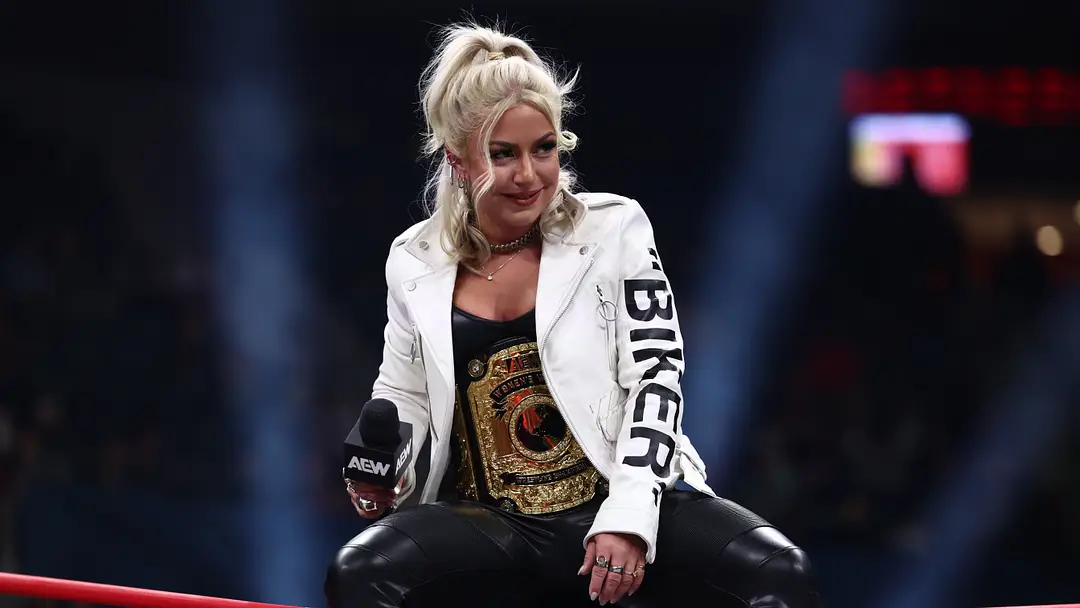
    She stumbled into professional wrestling at a punk-rock show in Vienna when she was 19 years old. Now, at 33, Thekla is the AEW Women’s World Champion.

    There is a version of this story where Thekla Kaischauri never makes it. Where the girl from Vienna with the punk band and the fine arts degree stays on that side of the world, making paintings and playing guitar, and professional wrestling remains just a strange thing she once stumbled into at a show.

    That version does not exist. It never really had a chance.

    An Unlikely Beginning

    Born April 30, 1993, in Vienna, Austria, Thekla holds a Master of Fine Arts degree from the University of Applied Arts Vienna. She describes herself as a creative kid who tried everything — comics, guitar, painting — before finding her true calling in the most unexpected of venues.

    She stumbled into her first taste of wrestling at a local punk-rock show at age 19 and swiftly became obsessed with the bizarre nature of what she witnessed. That obsession would reshape the rest of her life.

    She began her wrestling journey in 2017 in Vienna’s underground scene — a world of pub basements, no ropes and loosely enforced rules that bore little resemblance to mainstream professional wrestling. Her first match in a traditional ring did not come until April 2018, when she competed for Independent Pro Wrestling Germany in Lübeck. Her unconventional entry into the business turned out to be an asset. Having not grown up immersed in wrestling history, she developed a style and character drawn from a far wider range of influences — art, music, punk culture — giving her a creative freedom that more traditionally trained wrestlers rarely possess.

    Japan: A Wrestler is Born

    If Vienna gave Thekla a foundation, Japan built the house.

    She considers herself Japan-bred, having worked within the wrestling-obsessed country as early as late 2017. Being the only foreigner in promotions stacked with elite talent forced rapid development. She did not speak the language at first, and the culture surrounding professional wrestling was unlike anything she had encountered in Europe. The crucible made her.

    In late 2021, Thekla made the leap to World Wonder Ring Stardom, where she worked alongside bigger names such as Giulia and Mina Shirakawa. She competed there through 2025, becoming one of the few high-profile gaijin — foreign wrestlers — to establish herself meaningfully in Japanese women’s wrestling.

    Her time in Japan was not limited to the ring. During her years in Tokyo, Thekla exhibited her artwork in three solo exhibitions, including one at the Austrian Embassy in Tokyo — a reminder that the artist and the athlete were never far apart.

    The Move to AEW

    Thekla officially completed her contractual obligations with Stardom following the promotion’s All-Star Grand Queendom event on April 27, 2025. Her departure was marked by a storyline firing angle after her match, providing a definitive end to her successful run there.

    The American wrestling market came calling quickly. Reports indicated that WWE had its eye on her and that All Elite Wrestling had developed significant interest toward the end of 2024. She chose AEW, making her on-screen debut May 28, 2025, on Dynamite.

    The Toxic Spider

    What separates Thekla from the rest of the AEW women’s roster is not just her background — it is how all of that background manifests the moment she steps through the curtain.

    She carries herself with the effortless menace of someone who has nothing left to prove and everything left to take. Her in-ring style is chaotic and precise in equal measure — limb-targeting submissions wound around spider-like movement, sudden bursts of violence punctuated by a cold, unhurried composure that makes her more unsettling than any screaming heel on the roster. She does not chase the crowd’s reaction. She makes the crowd chase her.

    The nickname fits. The Toxic Spider does not brawl. She traps.

    Champion

    The payoff came on Feb. 11, 2026, when Thekla defeated Kris Statlander in a strap match on Dynamite to capture the AEW Women’s World Championship. She is now the reigning champion and a member of the Triangle of Madness stable alongside Julia Hart and Skye Blue.

    The stable also represented AEW in the CMLL Grand Prix de Amazonas at Arena Mexico in October 2025, marking Thekla’s lucha libre debut and underscoring the global footprint she has built across three continents.


    For fans who are only now discovering her, the career arc speaks for itself — from a punk show in Vienna, to the dojos of Tokyo, to the top of one of America’s premier wrestling promotions. She did not take the expected road. She did not take any road at all. She carved through the wilderness on her own terms, and now she stands at the summit holding a championship that looks like it was made for her. Maybe it was.


  • Top 10 Greatest Mic Workers in Pro Wrestling History

    Top 10 Greatest Mic Workers in Pro Wrestling History

    A finishing move can end a match. A great promo can end a career — or launch one into the stratosphere. These 10 wrestlers understood something most never fully grasp: in professional wrestling, the microphone is the most dangerous weapon in the building.


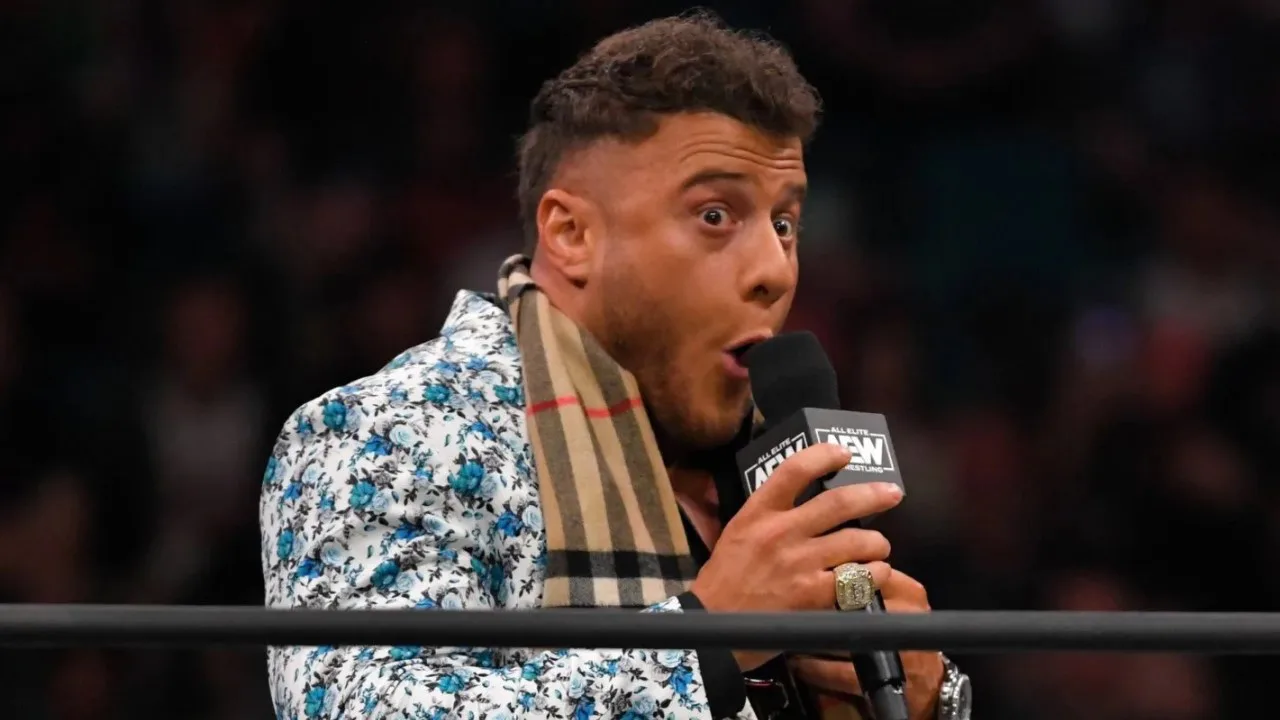
    10. MJF

    AEW • 2019–PRESENT

    Maxwell Jacob Friedman is the best heel talker of his generation and the strongest argument that elite mic work is not a relic of a previous era. MJF is clearly a student of the game. His promos are technically constructed with the precision of a trained writer — knowing exactly when to go personal, when to break kayfabe and when to let the crowd’s hatred fuel the next sentence. Just recent turning 30, MJF has already produced promo work that belongs in the same conversation as the legends above him on this list. You can see bits and pieces from the rest of the field in his work  

    9. Steve Austin

    WCW / WWE • 1989–2003

    Stone Cold Steve Austin’s mic work was deceptively simple — short sentences, blue collar attitude and a consistent philosophical code about beer, stubbornness and not taking orders. That simplicity was pure genius, because every word Austin said felt like something a real person in the audience would actually think or want to say themselves. His promos didn’t just over deliver on crowd reaction; they created a cultural identity that resonated far beyond wrestling fans. Add in the raspy Texas accent and 99% of the time you could feel his words.

    8. John Cena

    WWE • 2000–2025

    John Cena’s mic work is one of the most underrated in wrestling history, largely because his babyface run drew so much heat that fans overlooked how technically accomplished he was at promos. His rap-influenced early character gave him a comedic edge and quick wittedness that few main event stars of his era could match. When Cena went serious — particularly in feuds with CM Punk and The Rock — he consistently delivered the kind of composed, layered promo work that belongs in any legitimate conversation about the best talkers of his generation.

    7. Paul Heyman

    ECW / WCW / WWE • 1987–PRESENT

    Paul Heyman is the closest thing to a pure orator professional wrestling has ever produced — a man who could take the most absurd premise and present it with the conviction of a closing argument before a jury. As both a performer and an advocate for Brock Lesnar, he demonstrated that great mic work is fundamentally about persuasion, not volume. His promos don’t just sell matches; they reframe the entire narrative around his client as inevitable and undeniable. 

    6.  Roddy Piper

    NWA / WCW / WWE • 1975–2011

    Roddy Piper was the original unpredictable — a man who could shift from hilarious to genuinely unnerving in a single sentence, and frequently did. His Piper’s Pit segments set the template for the wrestling talk show format precisely because he could not be scripted into a corner; he found the live wire in every exchange and grabbed it with both hands. Piper’s gift was making everyone around him seem like they were improvising just to keep up.

    5. Jake “The Snake” Roberts

    WWE / WCW / INDIES • 1974–2018

    Where most wrestlers screamed to get their point across, Jake Roberts whispered — and arenas went dead silent. His mic work was psychological rather than theatrical, built on menace, metaphor and the unsettling calm of a man who had already decided what he was going to do to you. Roberts proved that restraint could be more terrifying than anything a louder wrestler could offer.

    4. The Rock

    WWE • 1996–PRESENT

    The Rock turned catchphrases into cultural currency and crowd work into an art form, operating on a comedic timing and rhythm that most stand-up comedians would envy. His genius was making the audience feel like participants rather than spectators — his call-and-response style gave arenas of 20,000 people the illusion they were having a private conversation with him. No wrestler before or since has crossed over into mainstream entertainment on the strength of mic work alone quite like Dwayne Johnson did.

    3.  CM Punk

    ROH / WWE / AEW • 2002–PRESENT

    CM Punk’s 2011 “pipe bomb” promo remains the most electrifying unscripted moment in modern wrestling, but it was no accident — it was the product of a career built on sharp, specific and brutally honest mic work. Punk spoke with the controlled rage of someone who actually meant every single word, which made him uniquely credible in an era of polished corporate promos. Even his detractors concede that when the microphone was in his hand, you could not change the channel.

    2.  Dusty Rhodes

    NWA / WCW / WWE • 1974–2010

    The American Dream spoke directly to working-class audiences in a way no other wrestler in history has managed to replicate. His promos were loose, rambling and deeply emotional — yet somehow always landed exactly where they needed to. Dusty turned vulnerability into a superpower, and crowds didn’t just cheer for him; they believed him.

    1.  Ric Flair

    NWA / WCW / WWE • 1972–2011

    No one in wrestling history combined volume, charisma and pure spectacle the way Ric Flair did every time he grabbed a microphone. His promos were operatic performances — part carnival barker, part Shakespearean villain — delivered with a conviction that made every word feel like gospel. Whether he was bragging about limousine rides and jet plane flights or begging for mercy on his knees, Flair was incapable of giving a dull moment. I’m sure if you asked all men ranked behind him, they would agree he would be #1.


    ALL OPINIONS ARE THOSE OF THE AUTHOR


  • Of Dawns and Twilights: New Day’s Impact in WWE | Column

    Of Dawns and Twilights: New Day’s Impact in WWE | Column

    “Don’t forget to smile in any situation. As long as you are alive, there will be better things later, and there will be many.” — Eiichiro Oda 


    Often in stories, I appreciate the funny moments. Bright, whimsical, wholesome, and full of light amid times of darkness and harsh realities. It makes those serious moments hit harder and reinforces that they do not last. Not so long as love and joy are to be found. That’s why the shock of New Day’s departure from WWE in 2026 struck wrestling fans so hard. Their impact is undeniable. Unforgettable. And now it reaches its dawn; night came without most knowing the moon circling its eternal orbit. On May 2, 2025, BodySlam’s own Cory Hayes and Fightful’s Sean Ross Sapp reported that New Day would mutually part ways with WWE.

    https://x.com/Cory_Hays407/status/2050592868863987915?s=20

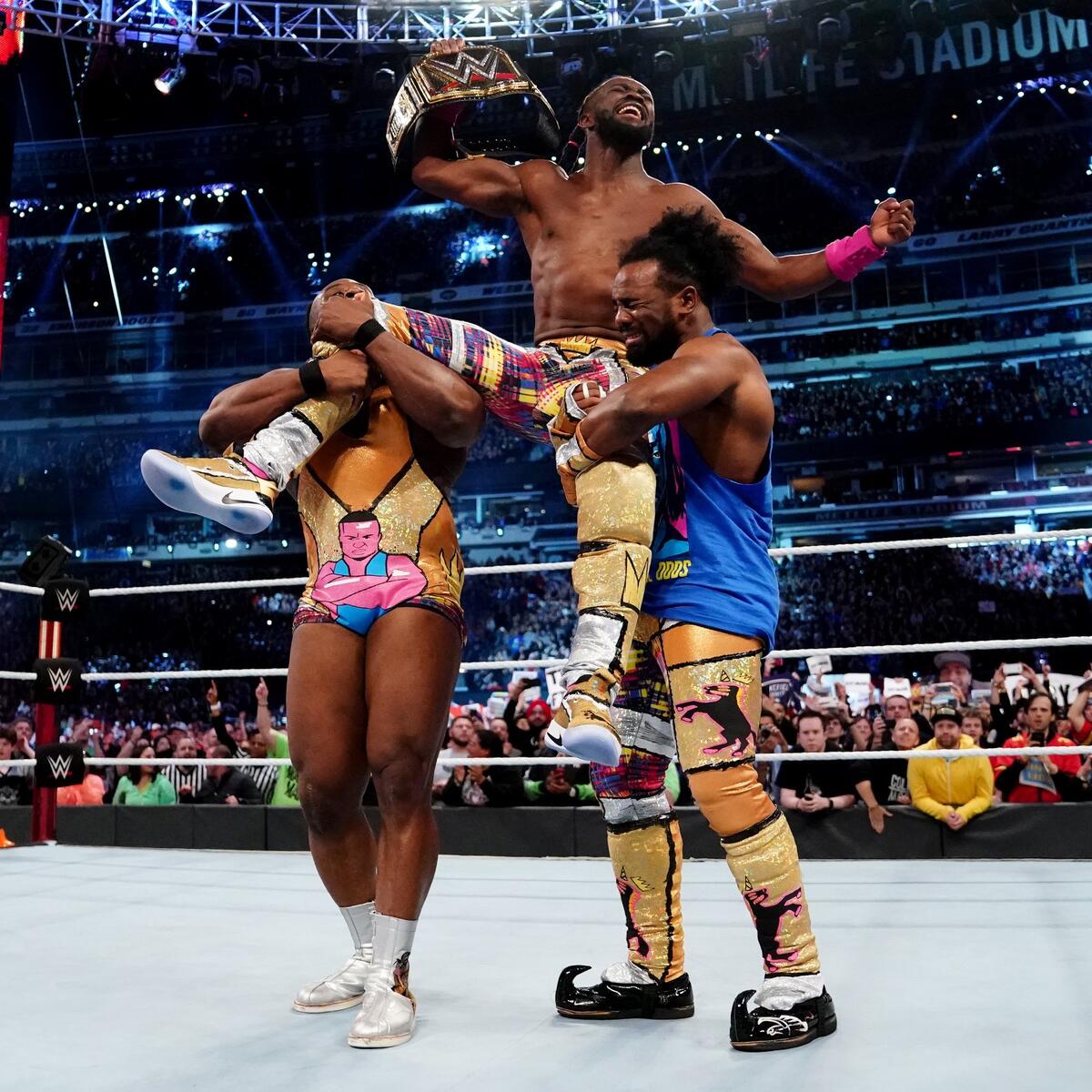
    For over a decade, the trio of Kofi Kingston, Xavier Woods, and Big E entertained fans. Sure, it took them a moment to find their identity, but when they did, something magical happened. There was a chemistry, a fire in three men who forged a brotherhood that brought laughs, tears, and memories even in the darkest of times.


    All three men were long-tenured. Their history is well-documented. Starting in 2014 with a gospel gimmick, New Day transitioned to a trio of goofballs who nerded out about anime, video games, and big meaty men slapping meat. Yet, they achieved greatness outside of the jokes.


    Fans eventually responded to this. They chanted “New Day sucks!”, which eventually transitioned to “New Day Rocks!” Over the years, New Day became a fixture in the company, where fans formed a strong connection. Woods would take advantage of this with a trombone to add an instrument to the crowd’s lyrics. Laughter would echo with every innuendo, pun, and joke. Audiences would join in with their catchphrases.


    From 2015 to 2016, the group held the WWE Tag Team Champions. Dethroning Tyson Kidd and Cesaro on the April 26 edition of the 2015 Extreme Rules became a huge moment for the stable. There, they would hold a record-breaking reign of 483 days thanks to Cesaro and Sheamus at 2016’s Roadblock: End of the Line on December 18. The Usos would surpass this reign on the November 11, 2022, episode of SmackDown. The Samoan brothers held the title for a 622-day reign.


    They’d continue onward to have an exciting run as the SmackDown Tag Team Champions, with wars against The Bludgeon Brothers, The Dudley Boyz, The Bar, Gallows and Anderson, and most notably, The Usos. The future Bloodline members had an intense rivalry with E, Woods, and Kingston, with their 2017 Hell in a Cell Match at the similarly named event being a standout. When asked about memorable Hell in a Cell bouts, many fans will likely point you to this one, outside of the Attitude Era and Ruthless Aggression Eras.

    The New Day vs. The Usos - Hell in a Cell Match SmackDown Tag Team Championship Match - Credit WWE
    Credit: WWE

    Considering the high unpopularity of the 2018-2022 era WWE, it’s remarkable that New Day had incredible moments that shone through the murk of bad booking and lazy creative. These years left many with a feeling that WWE was anti-fan. Though this sentiment hasn’t changed, especially in the company’s current climate, WWE allowed fans this one hope.


    KofiMania.


    After a heated Gauntlet Match on February 12, 2019, the veteran Kofi Kingston took part in a six-man Gauntlet Match. Due to an injury that derailed the originally planned contender, Mustafa Ali, Kingston was slotted into what was going to be a simple Elimination Chamber Match a week later.  Eliminating WWE Champion Daniel Bryan in an upset, Kingston’s hope diminished against the monstrous Samoa Joe. Squeaking by with a narrow elimination, Kingston suffered at the hands of the sore loser when AJ Styles came to his rescue.


    Then, something beautiful happened.


    Styles pleaded with Kingston that there would be no shame in forfeiting his spot in the gauntlet. He’d still make it to Elimination Chamber, he’d still be in the match. Kofi pushed back. Eleven years. He’d waited for this moment for eleven years. His voice quaked with something dissimilar to rage or pain; spirit coursed his very veins until the Phenomenal One acquiesced. They battled until Styles submitted him with a Calf Crusher. Ultimately, Kingston tapped in, as Big E and Xavier Woods helped him to the back.

    Kingston, despite the setback, had insane, insane momentum behind him as fans roared for his achievements and booed his setbacks. To me, this was the moment KofiMania hooked me. Right there, from the get-go. The Elimination Chamber Match, the subsequent gauntlet matches, and social media promos from Big E and Xavier Woods, and the win over WWE Champion Daniel Bryan at WrestleMania 35, all from this moment.


    That emotional win at Mania will stick with fans forever, especially those watching in the moment. Tears flowing from Xavier Woods, Big E beaming, Kofi overwhelmed with both emotion and sweat. Even his children joined him in the ring.


    The less said about how his reign was handled, let alone ended, the better. 


    Big E’s eventual title ascension proved to be just as hopeful and inspirational when he dashed Seth Rollins’s Money in the Bank aspirations with a Big Ending. He’d then grab the briefcase and fight to contain his emotions as he celebrated. He’d later cash it in on Bobby Lashley for the WWE Championship on the September 13, 2021, episode of Raw to great success.


    The less said about how his reign was handled, let alone ended, like Kingston’s, the better.


    Tragedy would strike on WrestleMania 38, when he suffered a botched overhead belly-to-belly suplex from Ridge Holland. This resulted in a broken neck, with fractures to his vertebrae. To date, he’s gone on to say that he’s effectively retired from pro wrestling action.


    Alone again, Kingston and Woods marched on. They’d cause a stir of controversy on the heels of 2022’s NXT Deadline. Unseating Pretty Deadly as NXT Tag Team Champions, New Day thus became WWE Tag Team Triple Crown Champions.


    Over the subsequent years, Kings and Woods grew progressively at odds with each other. From Karrion Kross and The Final Testament to Oddysey Jones and the LWO, it was clear they weren’t as communicative. Week after week, they’d bicker, and things weren’t as funny or lighthearted. Woods and Kingston brought out unbridled vitriol, soon to bubble over.


    The pair agreed in December to hold a 10th anniversary celebration of the team’s formation. There, they mourned Big E’s absence and stated that they’ve grown apart. Big E, who’d been mostly seen on pre-shows and interviews, joined them. The former WWE Champion begged them to stay together, that he’d join them as manager until he’s ever cleared. For Kingston and Woods, it was far, far too late. He could have come back at any moment, but he chose to leave it behind until they were about to leave it behind. No, they wouldn’t allow it. Effectively turning heel, Kingston and Woods evicted Big E from the group. Albeit this excommunication, E had small solace, knowing his brothers would remain together.

    The New Day, sans Big E, won their last WWE title together at WrestleMania 41, Night One, from War Raiders. Woods and Kingston held the World Tag Team Championships for 72 days before losing them to Finn Balor and JD McDonagh of the Judgement Day on the June 30, 2025, episode of Raw.


    Taking Grayson Waller under their tutelage, Kingston and Woods simply existed for a time, mostly in backstage segments, before finally departing from WWE mutually on May 2, 2026.


    So ends the New Day.


    It’s been bittersweet writing this up. All of the bright moments, the levity and joy these three men brought, I’ve enjoyed reliving. The New Day’s Dragon Ball Z-inspired gear at WrestleMania 32 was forever made iconic with their giant box of Booty-O’s. Their reaction to Xavier Woods falling prey to a Stone Cold Stunner by “Stone Cold” Steve Austin at the same event. Their hilarious back-and-forth promo with The Rock. The wins, the losses, and the everything in between.


    They were guaranteed smiles from crowds and viewers at home. That connection isn’t easy for most to establish, but they made it seem so effortless. Moreover, they were outspoken on their stances on current events, such as Hulk Hogan’s return to WWE or the Black Lives Matter movement. Additionally, their feuds in 2017-18 injected life into WWE’s tag team division, particularly their rivalry with The Usos.


    Considering these accolades and achievements and reputation, the fact that fans wanted so much more than the company had been willing to give to New Day is a testament to the stable’s unwavering power. I attribute this to the human story of this, told through comedy, tragedy, heartbreak, and glory. In a world where things are made corporate for the sake of content, there was art, there was feeling, and damn it all to hell, there was soul.


    Wherever Kofi and Xavier go, I hope they find great fun and success in it. Personally and selfishly, I’d love to see dream matches in AEW against The Young Bucks, The Rascalz, RPG Vice, and more. They are quite well-suited to the company’s PWG-esque tags and multi-man matches. Away from the lens of WWE, I’m curious to see how they’d fare. Of course, if they run the independent route, they have the means to comfortably do so. Either way, I support what they and Big E do from here on out, together or separate.

    The New Day in Dragon Ball Z gear in front of a giant Booty-O's Box at WrestleMania 32
    Credit: WWE

    In any day’s cycle, there’s a dawn and a dusk. New Day just so happened to eclipse its twilight.


    But it’s not the end, never the end. When night comes and goes, and the moon dips beneath the sea, the morning will come.


    And there will come a new day, yes, it will.

  • Why Wrestling Companies Must Improve Security for Talent

    Why Wrestling Companies Must Improve Security for Talent

    The opinions shared in this article belong to its author and do not reflect the consensus of the BodySlam staff.


    Try these shoes on: You’re a performer, with a huge stage to apply your craft. People cheer for you. They wear clothes designed in your image. There are signs they hold up and merchandise of you that they carry. You feel good, flattered, if you’re not used to it. Alternatively, you’re almost numb to it by now, but you’re still appreciative, because these people are the reason you get to live this life. And then it happens. They cross a boundary. Swarming their golden gods, they shove photos, merchandise, and toys, demanding talents sign them. Phones are pulled out for selfies and candid photos. For professional wrestling talents, this is an encounter they face all too often across their travels.


    Recently, during WrestleMania 42 weekend, that was the case. In Las Vegas, fans overwhelmed the talents. Booker T had fans follow him into the bathroom, according to his Reality of Wrestling podcast. Bayley and AJ Lee tried to share a quiet, emotional moment, likely before parting ways; Lee had an emotional title loss at the Showcase of the Immortals. CM Punk had to step in, confronting the fan and slapping the phone out of his hands.


    https://x.com/TMZ/status/2046219652762567025?s=20


    It’s a tale as old as time. Wrestlers post about it all the time, asking fans not to cross boundaries so they can simply go about their day. The show is over; there’s no meet-and-greet or convention. All there is is moving from one place to another or ordering something for the road. Sure, they’re happy to see viewers admire their work. A lot goes into it. For every botch, there’s a move that was executed to surgical precision. Promos are delivered in the hopes that their charisma will funnel into the fans’ subconscious, as wrestling psychologically does.


    In that is a catharsis. But that line between performer and spectator is sacred, unless otherwise invited in.


    Nobody wants to be made anxious about such a predicament. Going outside shouldn’t necessitate a horde of people frothing at the mouth for an interaction. Sadly, it doesn’t work that way. Having a life outside of home and the squared circle is mostly a risk, one that talents might not be fully equipped to handle.


    This follows everyone. Most often, though, it happens to women.


    I don’t think I need to explain how women are often overcrowded, regardless of their following. Even if they’re not trying to present themselves as someone to gaze at, it still happens, regardless of the gender assigned to the fans that follow them, mostly male. Provided the societal treatment of women since the dawn of time, this doesn’t stop at signing things or taking selfies.


    Women wrestlers are often the prime targets. No matter what percentage of skin is showing, they have a line that fans should not cross. It happens anyway. They could dress modestly, outside of their gear, in ways that heavily mute the features that are subject to such ogling. It still happens anyway. Not having the autonomy to dress however one wants without worrying about the intrusive hands of unwanted hands, it’s a scary existence.


    CM Punk shouldn’t have had to step in for AJ Lee and Bayley. The man who invaded the house of Daria Rae (formerly WWE’s Sonya DeVille) in Summer 2020 shouldn’t have happened. Rhea Ripley shouldn’t need to take to X and ask fans to breach her orbit to sign their stuff, or for people not to send things to her personal home address. Asuka has also reported that she’s afraid of being around fans because of the same treatment and those trying to romantically engage with her.


    I recognize that many of these wrestlers are incredibly successful, and that there is a litany of other bad things happening in the world. Poverty, evil billionaires, bigotry, and global warming. That said, entertainers should not have to beg for people to recognize them as people, not idols to be worshipped.


    Women in general should not have to live their lives with their heads on a swivel. Why else do would they hope to have a partner or friend in their life, so that they can turn their brain off in public? What other reason are they afraid to go out alone at night? Only then will they not need to answer “man or bear” with the latter.


    And now I move onto the recent topic of Elayna Black (formerly Cora Jade of WWE), that same WrestleMania 42 weekend at WrestleCon. A man groped her without consent and attempted to walk off. She took out her phone, recorded a video of his face as she confronted him. Largely, she received support for standing up for herself.


    https://x.com/KCwrestles/status/2045573510039568598?s=20


    Yet others were jumping to defend her harasser. Chief among these responses were people decrying her OnlyFans career, as though that justified his actions. She, as a wrestler, is free to handle her own branding just as her male peers are.


    Under no circumstances, and I mean in no uncertain terms, is it okay to touch anyone or make any comment that would make them uncomfortable. That includes performers and people in our daily lives. But it also extends to NSFW content creators, adult film stars, and dancers at strip clubs. Everyone should be free from inappropriate handling. Everyone. Yes, even you. Without enthusiastic consent, this is disgusting behavior. People, decent people, should never act like this.


    In terms of sex workers or anything adjacent, once they stop performing for the screen or on a stage, that’s where it ends. The nature of their profession is not an invitation to treat them however anyone pleases. What consenting adults do with partners or people they share intimacy or desires with is their business. It’s no different from anyone who doesn’t have that career. I might add that if it weren’t for men lusting after and treating women as sexual objects in the first place, this career might not exist in the first place. Supply and demand. 


    If it bothers a fan so much, my advice is this: stay away from it. Turn that phone off. Block it from personal social media. But do not condone this. Otherwise, it’s all men until women can feel safe and secure around men. 


    This also applies to male victims and victims outside of the gender binary. No one should be made to fear their surroundings.


    But I expect people to continue vehemently defending harassing and assaulting people. These are the types of people who women will cross the street just to avoid.


    Returning to the message at hand, there’s a parasocial nature to interactions that creates, nurtures, and perpetuates the interactions that leave wrestlers exhausted, or worse, afraid.


    WWE's Asuka 'feeling in danger', warn fans about 'romantic' advances
    Credit: @WWEAsuka, X


    All of those stories about wrestlers, actors, and musicians acting grumpily, at times angrily, at fans can be attributed to the lack of space and respect. Nobody should have to see John Cena calmly, yet visibly irritatedly ask fans to respect his privacy and boundaries. Chappel Roan’s enforcement of her line between her time away from music to be mired with constant interactions with strangers should not warrant controversy.


    Existing abroad in the public eye is not permission. If any celebrity, be they online, in wrestling, or in pop culture, welcomes an interaction, leave it at what they are willing to allow. Then leave it at that. If they don’t offer it, leave them alone. The interaction between performer and fan starts and stops at that moment, unless both parties agree to continue it. 


    In a perfect world, educating people on etiquette, on treating others respectfully, would alleviate so much of this. Unfortunately, we don’t live in such a world. Empathy is but a foreign concept for people who don’t step out of their own shoes.


    Circling back to WrestleMania 42 and the flood of fans that left wrestlers with a negative experience, the last and most crucial aspect to consider is security.


    Throughout that weekend, it was noted that the local security at Las Vegas’s MGM Grand wasn’t equipped for the influx of fans. When Fightful Select released their report on WWE and hotel security, they painted a dismal picture that highlights the unsafe environment of simply staying at a place to unwind and rest.


    Factoring in that Vegas hotel security already has far more to deal with, it would make sense that a multi-billion-dollar corporation like TKO, and by extension WWE, would heighten security for the people who make their product work in the first place.


    There’s a lot to weigh in on how fans treat talent. Many are socially unaware (either by lack of education, social conditioning, or lacking socially cognitive skills), while others are predatory. From the lustful fans to the ones who would exploit their own children to get something signed, it’s disturbing that these people operate in such a way. Additionally, some of these fans are trying to take shortcuts to meet and get things signed due to WWE’s current business model already overprices almost everything from merch to tickets to meet-and-greets.


    But the company should be held responsible for the fans’ handling of talents in public. Surely, with WrestleManias and Royal Rumbles being held in Saudi Arabia from the pocket of royalty, WWE could afford this. Surely, with the high costs of being a fan, WWE could afford this. Surely, from cutting talent, WWE could feasibly afford to ensure the safety of its most essential contributors.


    With the wealth the company touts, it begs the question: at what length would the company go to ensure the proper satisfaction of fans and talent alike?


    Considering how they value their bottom dollar, I think I know the answer.

  • Berwyn Eagles Club: What It All Meant in the End

    Berwyn Eagles Club: What It All Meant in the End

    This is a piece paying tribute to the place of the Berwyn Eagles Club venue in pro wrestling and what it meant to so many. Since the Club is set to lose a main source of income, here is a GoFundMe campaign to help venue owner Chuck Marose Sr in the aftermath.


    Across the street from a Mexican restaurant and an ice cream parlor, next door to a car wash, sits a simple place. Nothing crazy about it that screams for more attention than most. A small one with a pronounced sign outside. Much of it is hugged by verdant greenery en route to a dark wooden door; the rectangular pavement in front of it is cracked. Once glance at the blue sign, “Berwyn Eagles” with the titular bird breaching containment atop it. Yep, you’re there at Chicago’s local independent wrestling haven, Berwyn Eagles Club.


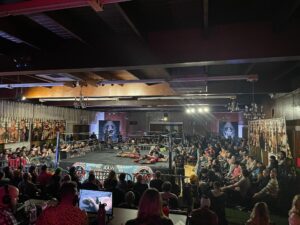
    Immediately, the clammy stench of history envelopes you. The arena is compact; the Club’s breadth is intimate—the type of place where people are packed like sardines, within intimate proximity to each other. Hardwood flooring and walls house chandeliers, embodying an atmosphere of Reagan-era structure, a time capsule of the 1980s. As you walk through the halls, 8×10 posters invite you further, making it clear that you’re going to be in the midst of an art unrestrained by the global and corporately controlled capitalism outside. These posters continue into the side and main bar. The world is on fire, but inside, there’s the comfort of great vibes and storytelling in the guise of sport. 

    An AAW show in Berwyn Eagle Club's interior
    Credit: AAW Wrestling

    This main bar, that’s the entrance where fiction struts through the reality that cheers and jeers it. It has two doors, but only one is used for the performer’s entrances. Fans can be seen dipping in and out of the bar or visiting their ATM, hopefully having enough in their account to withdraw.


    Wrestlers hang out backstage, sharing drinks and laughs at the bar. Every so often, if your eye strays enough from the bombastic theater unfurling before you, it might catch sight of wrestlers high and low on the card watching from the entrance and backstage.


     The smell of alcohol and paraphernalia permeates the air. A scent of perspiration soon wafts its foul air. One does not go to independent wrestling shows to be in the presence of aesthetics and sweet aromas. No, this was a place where you forget your troubles and get in the pit of sweat and rage and the masquerade of sport. Where heartache, comedy, hopes, and dreams come to a modest square.


    The Berwyn Eagles Club has hosted this wrestling for over 20 years. In the American Midwest, it was the place to be. A place where, if wrestlers were positioned to be a big player in the independent wrestling scene, they went here. Seth Rollins, Kevin Owens, Bryan Danielson, Beth Phoenix, Sami Zayn, Claudio Castagnoli, Becky Lynch, Nattie Neidhart, Athena, and Asuka are just a few.

    https://x.com/OGHank312/status/2042683209004048500?s=20

    For the nostalgic CM Punk fans, this is where he made his first wrestling appearance since winning the WWE Championship from John Cena at Money in the Bank in 2011. Yes, where he praised the courage of Gregory Iron, a wrestler living with Cerebral Palsy. It was there, in Berwyn, at AAW’s “Scars and Stripes.”


    During Cody Rhodes, Drew McIntyre, and Matt Cardona’s indie reinvention runs, they too circled through its wooden palace. From residential lucha promotions to Wrestle League and Squared Circle Superstars, attendees could expect all the charm of indie wrestling. Yet, chief among these were AAW and the all-female SHIMMER wrestling promotion.


    That’s the impact of the Berwyn Eagles Club. It doesn’t have a history solely in independent wrestling, but in the overall industry as a whole. Whether it was the loyal talents or the ones who compete under blinding lights, wrestling came through here. Just as Reseda was to PWG, Korakuen Hall is to Japan, Arena Mexico to Mexico, and Madison Square Garden is to WWE, Berwyn is to Chicago. 


    Unfortunately, its place in wrestling history is set to dissipate. On March 28, an incident took place in which a fan allegedly stabbed wrestler Krule at a Ruthless Pro Wrestling event in Berwyn, Illinois.


    Videos of the event showed no signs of weaponry for Krule to be stabbed with, only a brawl at a nearby merchandise table. According to an incident report researched by John Pollock of POST Wrestling, the local Berwyn Police Department stated that no stabbings took place at the venue.


    I’m not going to get into the specifics of who said what or what I believe happened. There’s plenty of that to go around. What I want to do is to capture its place in wrestling the best way I can: conveying vibes.


    Why? 


    Because, as the world of wrestling changes drastically with every passing month, it’s important to remember. And I want people to do just that—remember. No one who holds wrestling fondly in their hearts should forget Reseda. They should also keep Berwyn in their hearts for the same reason. What may seem to some to be a small, rinky-dink place was, to others, a livelihood and a way to step into superstardom. It was home, and it was a dream. 


    I’m only a wrestling fan, though. A microcosm of a wider field, a raindrop in a river. To me, a Missouri boy, my state has its own relevance to pro wrestling with Kansas City and St. Louis. Yet in Chicago, Berwyn will remain one of the most essential veins running to the heart of Midwest pro wrestling. 


    As AAW’s event, Crush & Destroy, approaches its April 24 date, you can expect to see people talking about what this venue means to them. This is where indie wrestling in the Midwest came to its local hotspot. Fans will talk about where they were at distinct moments within their quickly moving lives. Maybe which wrestler they saw at certain points in their career. Wrestlers will wax nostalgic about their glory days, exciting matches they had, and appreciate the moments that made them. 


    You may also come across posts from wrestlers on social media whose lives are intrinsically tied to the place. People like Shane Hollister, Nicole Matthews, Trent Zuberi, and Shazza McKenzie may be among those names. Talents from AAW and SHIMMER, alongside talents that have passed through its doors and gone on to other places.

    https://x.com/AAWPro/status/2042377633250377917?s=20

    If you’re in the Chicago area, consider giving it a visit; purchase a ticket and show up on Friday evening, and witness a moment in wrestling history. If you can’t be there, you can watch from Highspots.TV, YouTube, or TrillerTV.


    Crush & Destroy’s card will feature talents like Rich Swann, Robert Anthony, Joe Alonso, Trevor Lee, Maggie Lee, Heather Reckless, and many more to keep your eye on.


    Pro wrestling is at a stage where it constantly changes. Everything’s in flux. For every evolution, there’s a dissolution. In their wake, they leave memories. These last moments of grappling action? Those memories will be filled with blood, sweat, and undoubtedly, tears.


    So here’s to the final memories of wrestling fans’ third place, a place to gather away from home. Here’s to the finale of the Berwyn Eagles Club in pro wrestling.


  • No Flips, Just Fists: A Tribute to Dax Harwood & Cash Wheeler

    No Flips, Just Fists: A Tribute to Dax Harwood & Cash Wheeler

    By Mark O’Brien (@WrestleMobs)

    There is a car park outside the Curtis Culwell ntre in Garland, Texas, that I will carry with me for the rest of my life.

    I sat there for an hour after Supercard of Honor XV on Friday, 1 April 2022. I had just watched FTR beat The Briscoes in twenty-seven minutes and twenty-five seconds to win the ROH World Tag Team Championship. And something inside me, something I had been dragging around for five years, had just broken open.

    I want to write about FTR — Dax Harwood and Cash Wheeler — because they are, without qualification or hedging, the greatest tag team of their generation, and one of the greatest tag teams ever to lace boots. That is the tribute I owe them as a fan and writer. But I cannot write that piece honestly without telling you what they did for me personally one night in Garland, because it is the reason I am here to write anything at all.

    This is a piece about craft. It is also a piece about being met at the right moment by the right thing.

    Case on Its Merits

    Before anything personal, the case on its own terms.

    FTR’s claim to tag team greatness is not a vibe or a marketing line. It is quantified and qualified in a ledger. In WWE as The Revival, Dax Harwood and Cash Wheeler — then Scott Dawson and Dash Wilder — became the first team in company history to hold the NXT, Raw, and SmackDown tag titles. First ever Triple Crown tag team champions. They did that while the company was actively trying to bury the division, while creative kept workshopping gimmicks nobody wanted, while a main roster run that should have been a coronation became an exercise in institutional indifference. They won anyway. They won because they were better than what they were being asked to do.

    They left. They spent two months on Dynamite in the summer of 2020 wrestling without a contract, because Tony Khan asked them to and they believed him. When they eventually signed, they were babyfaces because they had saved The Young Bucks from an attack — a bit of writing that is almost too neat when you consider how long those two teams would go on to define each other. They won the AEW World Tag Team Championships at All Out 2020 from Hangman Page and Kenny Omega. They lost them. They got them back. They got them back again. They are now three-time AEW World Tag Team Champions, tied for the record.

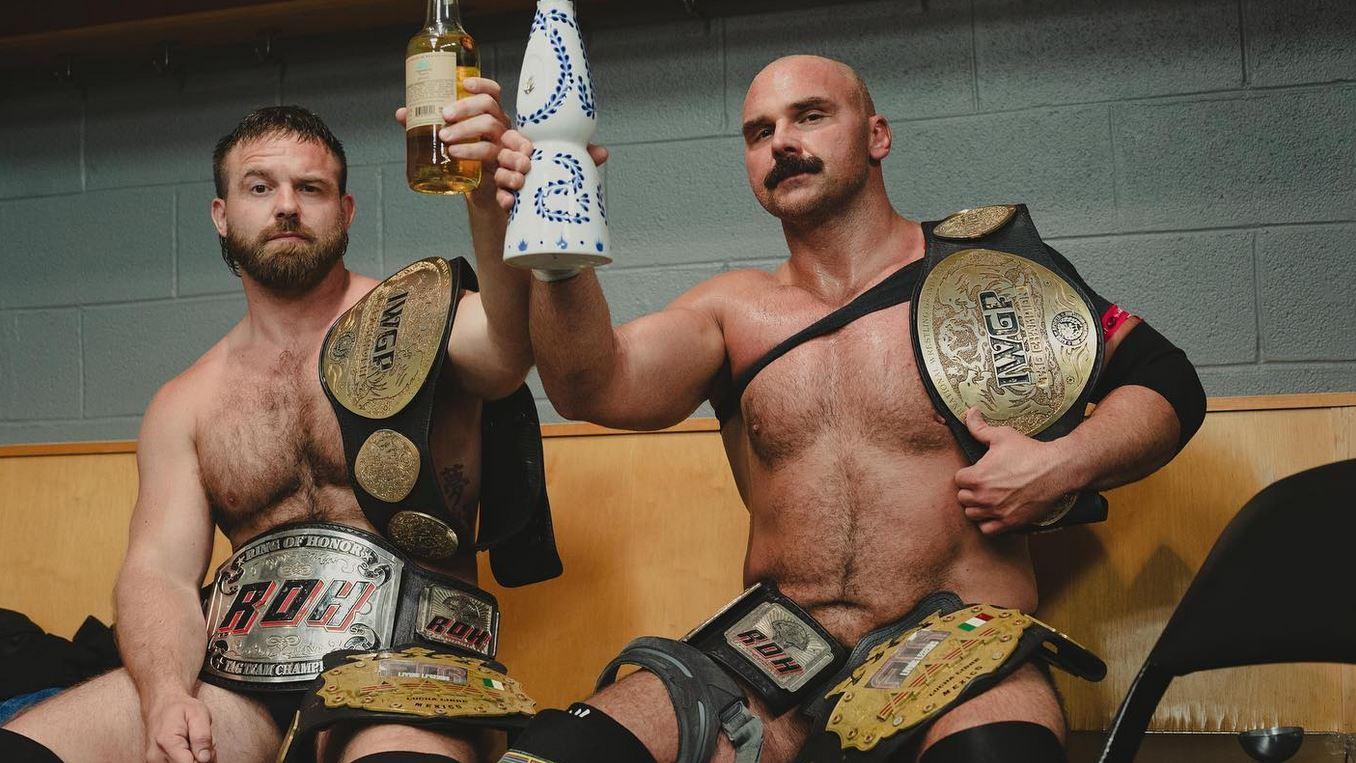
    They won the IWGP Tag Team Championships at Forbidden Door. They won the AAA World Tag Team Championships. They won the ROH World Tag Team Championships — twice — and the first of those reigns is the one I am going to come back to, because it happened in Garland.

    They did all of this while wrestling a style that, on paper, was a commercial suicide pact. “No flips, just fists.” A throwback to an era most of their audience was not alive for. Southern tag wrestling. Brainbusters. Midnight Express. Arn Anderson and Tully Blanchard. In an era where tag matches were increasingly sprints — dive festivals, four-way tornado spot-fests, every sequence trying to outdo the last — FTR went the other way. They slowed it down. They sold limbs. They built heat. They made you care about an arm bar in the year 2023.

    That is the craft argument. You can find a dozen versions of it written by better-credentialed people than me. What I want to add, because I am one of those who can, is what happens on the other side of the camera when two men are that good at what they do. What happens to the people who watch.

    Backstory

    Garland does not make sense without this section, so here it is, briefly.

    My mother died in 2017 after a long illness. In 2021 I broke my neck playing rugby, which ended a career I had been building since 2010 at various levels.

    So by the early months of 2022 I was grieving, without a sport, and without the particular outlet that a decade in rugby gives you for managing what is happening inside you. I had a professional career. I had the apparatus of a functional adult life. I had plenty to be getting on with.

    I flew to the United States that March with a friend to complete a bucket list activity, attending WrestleMania. However that weekend in Dallas had a separate card I could not look away from. FTR versus The Briscoes had been teased since Final Battle 2021, when Dax and Cash had shown up after The Briscoes’ twelfth ROH tag title win and sparked a pull-apart brawl. For anyone who had grown up on this stuff, this was the match.

    The show was on 1 April 2022. My mother’s anniversary was 4 days later. I did not plan it that way, purely coincidental.

    Garland

    The Curtis Culwell Center is not a cathedral. It is a multi-purpose arena in a Dallas suburb, the kind of building that hosts high school graduations and regional volleyball tournaments. Nine thousand seats. Low ceiling. It did not need to be a cathedral.

    The match itself is a twenty-seven-minute argument for professional wrestling as a serious art form. Two teams who had spent years being told they were the best of what was left of a dying form, finally in the same ring, with a belt on the line, on the first show of ROH’s new Tony Khan era. If you have not watched it, stop reading this and go watch it. I will wait.

    Back? Good.

    What FTR and The Briscoes did in Garland is the thing that, when it is done this well, cannot be done anywhere else. It is not film. It is not theatre. It is not sport. It is its own thing, and when it works, there is nothing else like it. They built the crowd from the first lockup. They told a story with bodies. The split crowd that became a unanimous one. The near falls that made grown men shriek. The moment in the final third when it stopped feeling like a match and started feeling like a vigil for a form of wrestling everyone in the room had been told was dead. FTR hit the Big Rig, Cash dove onto Jay, and Dax covered Mark for the pin. The referee’s hand came down. New champions.

    Something afterwards came loose in me.

    I do not fully understand, even now, the mechanism. I know there is a whole literature about catharsis, and I know that wrestling has always been a place where people who do not know how to process things go to process them by proxy. I know that watching two people do something with absolute competence and absolute love for the thing they are doing can reach parts of you that the conventional tools cannot. I know the timing mattered. I walked into that building 4 days before an anniversary I had been carrying quietly for years, and the building was ready for me in a way I had not been ready for it.

    I made it to the car park to call for an Uber. I sat there for an hour. And for the first time in a long time, I could breathe.

    I went to WrestleMania the next two nights. I could not tell you much about it, not a huge amount registered or landed in comparison with what I had seen the night prior. I was still in Garland.

    What Followed

    I want to be careful here, because stories about wrestling saving lives are stories wrestling tells itself, and some of them are true and some of them are nice myths, and the honest version of this one has to include the part the myth leaves out.

    Attending SuperCard of Honor, and seeing FTR vs Briscoes did not directly save my life, but it certainly opened a door. What I did after walking through it is what saved my life. That work was mine and most of it is not for a wrestling essay, but it was real and it took years and it is the reason the rest of this paragraph exists.

    I started writing about wrestling. I had never written about wrestling before. By the end of 2022 I had bylines at Bodyslam, then Wrestling Inc, Wrestlezone, Wrestle Inn, PW Musings and Voices of Wrestling. I started the WrestleMobs interview series with friends from the Irish Wrestling scene (Irish Wrestling Entertainment). I trained in a number of schools across Ireland and the UK. I wrestled on a handful of shows. I got invited to events and media junkets by WWE and AEW as credentialed media.

    In early 2023 I met Dax and Cash for the first time at a For the Love of Wrestling event in Manchester. I met them again the night before All In 2023 at Wembley — they invited me to spend time with them and colleagues, the night before the biggest wrestling show of all time. Same again the night before All In 2024. Same again before Forbidden Door 2025. Four separate occasions now where two men who owe me absolutely nothing have given me their time. I have not, in any of those meetings, told them the full version of the story in this essay, but I have certainly expressed parts of it, largely because there is no need. Men like Dax and Cash have met enough of us with similar stories to my night in Garland to understand the impact they have had on people’s lives, directly and indirectly.

    I applied to an MBA programme. I got into the top-ranked course in Europe, on a scholarship, which I still cannot quite believe when I write it out. I completed it. I graduated. I got consulting job I could only dream of, while coaching rugby at a semi professional level. I have a new relationship. There is a new life.

    I have bought, at last count, every piece of merchandise FTR have released since their WWE days. Every one. I have nearly every action figure. I scour eBay, Pro Wrestling Tees and the AEW shop at weekends looking for old drops. This is not a flex. This is how fans like me say thank you when we do not know how else to say it.

    What They Do, and Why It Matters

    I want to circle back to the craft, because I have buried the lead on purpose and now I want to dig it up.

    The thing FTR do, at their best, is the oldest thing in professional wrestling. They make you believe. Not in them — anyone charismatic can do that — but in the match. In the stakes. In the idea that an arm bar applied by a man who genuinely wants to hurt the other man is the most interesting thing in the world for the eight seconds it is happening.

    In a form that increasingly prizes the exceptional — the dive, the flip, the table spot, the shock — FTR prize the connective tissue. The transitions. The reason one thing leads to another. There is a structural intelligence to their work that I think is going to be studied by wrestlers fifty years from now the way good tag teams now study The Midnight Express tapes. They are teaching a style that was, on all reasonable forecasts, going to die with the men who invented it. It is not going to die. They have students now, whether they asked for them or not. The floor of tag team wrestling in AEW, ROH, and on the independent scene is higher because of them.

    And there is something else, which is harder to articulate and I will try anyway. There is a moral quality to what FTR do. Not moral in the puritan sense. Moral in the sense that there is a philosophy of labour underneath it. They show up. They do the work. They sell. They make the other team look good because the other team looking good is how the match looks good. They are pros in a sense that has been getting quietly vandalised in our culture for about thirty years. Watching them is, among other things, a reminder that there is dignity in being very, very good at a thing and caring about it more than you care about being seen caring about it.

    This is what was underneath my night of clarity in that Garland car park, I think. I had spent a decade in rugby, a sport that teaches you a particular relationship with your body and with effort, and I had lost that sport, and I had not replaced what it gave me. FTR, in Garland, for twenty-seven minutes, reminded me what it looks like when people love a craft enough to suffer for it in public. That is not nothing. In the right moment, on the right weekend, it is everything.

    What I Believe

    I have said versions of this to other fans in other rooms, and I believe it: there are people walking around alive today who would not be, if not for Dax Harwood and Cash Wheeler.

    I do not say it as hyperbole and I do not say it for effect. I have been in rooms with fans who have told me variations of similar stories. Wrestling as a form has a peculiar power to reach people who cannot be reached by the conventional apparatus of help. It finds men who will not go to therapy and women who have tried everything else, and it sneaks up on them through a form they were told as adults they were too smart to love, and it does its quiet work. FTR, because of the specific style they wrestle and the specific story they tell with their bodies, do this as well as anyone in the business right now.

    What FTR gave me, in the end, was not a distraction, cure or escape – it was a door — a specific door, opened on a specific night, at a specific moment, in a specific car park, far away from home — and a glimpse through it of what the next version of my life might look like. That glimpse was enough. The rest of it I managed with an awful lot of help, But I managed it because, for one night in Garland, Texas, two men who had once been told their style of wrestling was obsolete reminded me that sometimes the old forms are the ones that still work.

    I do not know how to end a piece like this, because the truth is that it has not ended. I will be at more FTR matches this year at AEW All In at Wembley Stadium on August 30th,  and RevPro 14th Anniversary show the night prior in Wembley Arena, and the year after, for however long Dax and Cash choose to keep doing this. I will buy the next t-shirt. I will chase down the next figure. I will write the next thing.

    But if you have read this far, and you have ever wondered what any of this is for — the wrestling, the fandom, the absurd devotion some of us bring to a form that much of the culture does not take seriously — I would offer, as my one piece of evidence, a car park in Garland, Texas, on a Friday night in April 2022. A person who had living in a dense fog for too long, sat on a kerb, finally able to breathe.

    That is what FTR did for me. That is the craft of Professional Wrestling.

    People walking around and thriving in life today is their legacy, and this is my tribute.

    No flips. Just fists. Thank you, Dax. Thank you, Cash.
  • WWE’s Future Runs Through Oba Femi

    WWE’s Future Runs Through Oba Femi

    From NXT standout to WrestleMania moment, Oba Femi’s rise signals WWE’s next dominant force.

    Oba Femi looks every bit like WWE’s next breakout star. The question is not whether he will become a main-event fixture, and future World Champion, but how quickly he will get there.

    The rise of Oba Femi is not built on hype alone. It is rooted in a background that mirrors many of the company’s most successful crossover athletes. Before stepping into the ring, Femi was a standout collegiate track and field athlete, specializing in the shot put. That foundation shows up immediately in his in-ring style. His power is not manufactured. It is real, explosive, and controlled. A once in a life time talent.

    Femi’s upbringing adds a layer of authenticity that cannot be taught. Born in Nigeria and later moving to the United Stares, he developed a blend of cultural discipline and adaptability that shows up every time he is on screen. There is a calm intensity in how he carries himself, rooted in lived experience rather than performance, and it translates into a presence that feels deliberate and controlled. He does not rely on over the top theatrics to sell dominance. Instead, his demeanor, pacing and body language project it naturally, giving him a credibility that many performers spend years trying to build.

    His journey to WWE came through the company’s NIL program, a pipeline designed to recruit elite athletes and mold them into performers. While many prospects take years to find their footing, Femi accelerated through the system. By the time he arrived in WWE NXT, he already looked comfortable under the bright lights.

    Femi’s NXT résume speaks for itself. He quickly established dominance, capturing gold and positioning himself as one of the brand’s most credible threats. More importantly, he did it with consistency. His matches told a clear story. His presence demanded attention. In a developmental system filled with potential, he separated himself as someone ready now. One would think he had 10 years of experience under his belt.

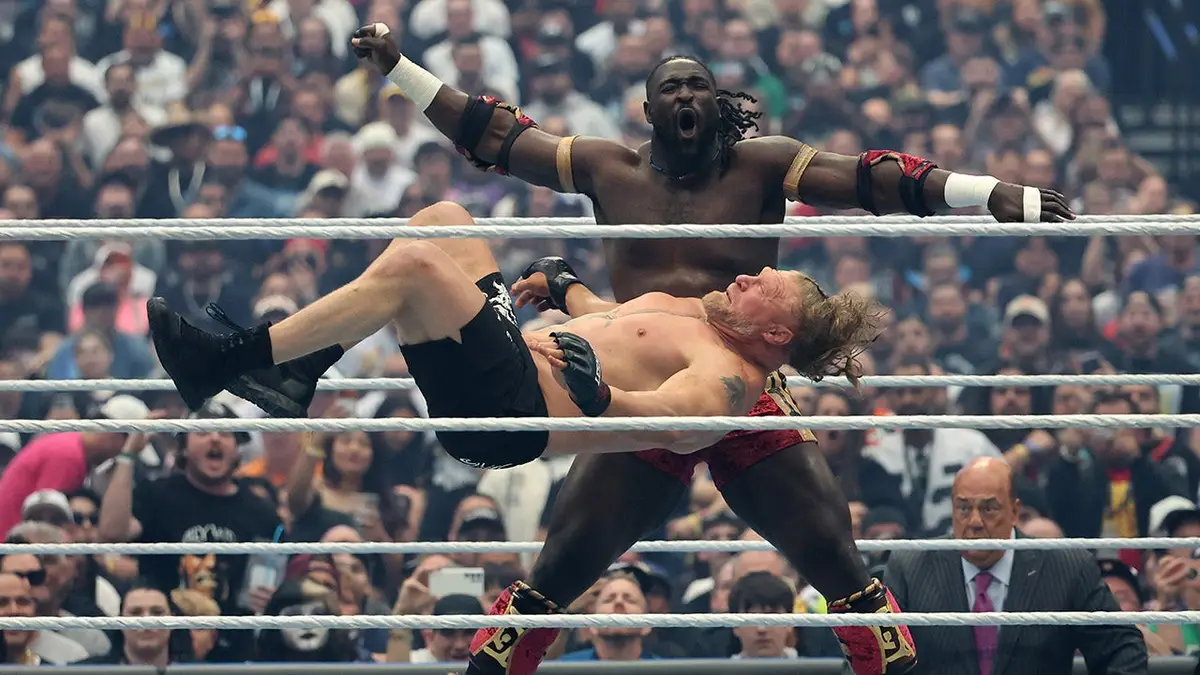
    That readiness led to his call-up, and WWE wasted little time placing him in a meaningful situation… Brock Lesnar. The defining moment came on the grandest stage of them all, at this past weekends WrestleMania 42. In a result that signaled a clear shift in direction, Femi defeated and surprisingly retired the living legend of Brock  Lesnar. If that’s not a new direction, then I don’t know what is.

    Moments like that are not handed out lightly. Lesnar has long been positioned as an attraction, a measuring stick reserved for only the most trusted talent. He is the most powerful and accomplished man in combat sports history. For Femi to be placed in that role, and to deliver, speaks volumes about how WWE views his ceiling.

    There is still work to be done. Charisma must continue to evolve. Storytelling will need to deepen. Those things will be fine tuned. But the foundation is already stronger than most at this stage.

    WWE has spent years searching for its next dominant force. In Oba Femi, it may have already found him.

  • EXCLUSIVE: New Details Revealed For TNA & QPW Co-Promoted SuperSlam 4 Event

    EXCLUSIVE: New Details Revealed For TNA & QPW Co-Promoted SuperSlam 4 Event

    Back in February, Bodyslam had exclusively reported that TNA Wrestling would be teaming up with Q Pro Wrestling (Formerly Qatar Pro Wrestling) for their annual SuperSlam 4 event in May, as a co-branded show.

    The event was to be held in Doha, Qatar, but this was before Qatar was involved of the United States and Iran turmoil back in March. However, the situation in the Middle East caused a postponement in the event.

    Sources close to the situation exclusively indicate to Bodyslam that the event will now take place on Saturday, October 24th, 2026 in Doha, Qatar.

    Top TNA star and current TNA International Champion Mustafa Ali is also the current QPW World Champion.

    Which talent TNA will be sending over for the event, and other possible events in the region have yet to be revealed. The event will air on TNA + and Triller.

    Bodyslam will continue to update as more information becomes available.

    (Please credit Bodyslam.net when using this news.)