

On December 13, 1993, Nirvana played to a hot Seattle crowd. Their “Live and Loud” set included hits like “All Apologies”, “Heart-Shaped Box”, “Come As You Are”, and many more. Moments before covering David Bowie’s “The Man Who Sold the World,” a fan yelled, “MTV sucks!”
Taking a drag from a cigarette, singer Kurt Cobain’s response was cavalier: “Then why are you here?” It wasn’t a condescending retort, but more of a “Yeah, we know what this is, but we’re still bringing something real.”
I think about that iconic moment. That sometimes the existence of art, in all its true humanity, the creator must make do with the slate they are given, even if marbled with industrialism. As the past decade has shown, that slate is often tainted. Whether it’s by capitalists or fellow artists, that soiling of the platform can leave a sour taste.
We will circle back to this and how it applies to tribalism in wrestling.
I’m sure by now that everyone’s likely tired of the discourse surrounding wrestling. I know I am. Watch whatever you want to watch and stop trying to justify why you do or don’t watch something. Being bitter online does nobody any favors.
In 2026, the landscape of wrestling has changed, and with it, the conversations surrounding the companies that peddle the art form. Accompanying it are the dangers of the terminally online. It’s a place drastically dwindling in nuance as media illiteracy rises and reading/listening comprehension falls. Common sense goes out of the window, and suddenly it’s a bit harder to enjoy this thing of ours.
It’s nothing new, however. It’s been around for eons, arguments about which wrestler, group, or company was the best. In the Internet Age, the ghost of digital footprints lingers in arguments that date as far back as the Monday Night Wars. All of the bickering, like children debating who the best Teenage Mutant Ninja Turtle was (it’s factually Mikey, by the way). The argument was always here.
And it’s unavoidable.
Often, people will point to it being a mostly online thing. Which is true. I’ve often left debates about wrestling without the same kind of uncomfortable feeling as doing it online. Not only is tone harder to read online, but it’s where the most stubborn of creatures lie. And try as one might, there’s just no changing someone’s mind.
However, it does trickle into real life. I’ve had a man, a grown man, go red in the face about how ROH and NJPW was better than WWE when I was a lapsed fan and didn’t know what was going on. People will defend these companies as though they owe their whole lives. As though they currently work there.
Online, the experience of being a wrestling fan is often filled with deleted drafts, unfollows, or unsubscriptions because of how far other fans will take things. Wrestling fans have to go to Discord servers, direct messages, and group chats just to enjoy programs or share jokes and criticism. Sometimes they just privatize their social media accounts.
There’s a nuance to the ever-changing world of wrestling that many aren’t privy to. To worry that a post will be willfully misconstrued or unnecessarily challenged is annoying. There are conversations to be had that can’t be placed on public social media because they simply don’t want to deal with other people. Whether it’s someone demanding wrestling be what they want it to be, a contest to see who’s the most loyal or cognizant fan, or how wrestling should be consumed, it just feels uncomfortable. No one wants to interact with human equivalents of soggy leftover bits of food remaining on dishes that somebody didn’t rinse off properly.
It’s no wonder that Kat Dennings and Timothée Chalamet tread carefully when speaking about their fandom. I’d imagine that could be a reason why Sabrina Carpenter has never publicly acknowledged wearing a Young Bucks T-shirt in her younger years.
I know I’m not alone. It’s why most people hide their appreciation for pro wrestling and why I’m sure most pro wrestlers want little to do with fans despite it being part of promoting themselves, and, I’m sure, deep down desires. Much like Cobain in 1993, wrestlers are aware of the beast that is the commercializing establishment. For some, reaching their dreams requires being a practitioner of selling themselves to fans, companies, advertisers, and agencies. It goes on and on. At times, dangerously so, as wrestlers can soon forget themselves and see only the brand they carry.
And yet, tribalism is a tool of theirs. At its roots, pro wrestling is a carny business, and to make it there and in entertainment as a whole, you have to preserve your self-interests with sincerity, whether it’s genuine or not. Pro wrestling rests on fans suspending their disbelief and buying into the morality play. In ways, it’s a beautiful art, and in others, it’s a clear indication of manipulation to get where they need to go. I’d imagine that the most conscious and self-aware must not feel good, but they grow numb to it. All the while, they’re supporting their buddies in different companies. The same promotions that fans will insult a wrestler for jumping ship to are being supported by the professionals that work for the alternative companies. The only people who see it as a competition are the promoters and the way-too-dedicated fans.
Wrestling promotions, too, often leverage tribalism to their own advantage. In fact, they’re often the best perpetrators. In the Monday Night Wars, WWF, WCW, and ECW pitted their passionate fans against their rival promotions. Whether referencing “sloppy shops” or “blood and guts,” AEW and WWE had previously shown themselves as not above this behavior. Granted, they’ve halted this on programming, as AEW’s previous jabs at WWE alienated a portion of the audience.
They’ve since rebounded from that. But the mere thought of even being tribalistic will continue to plague them. For example, recently, someone photoshopped AEW’s usual televised showcase of pro-AEW tweets to make it sound like an anti-WWE post made it to air. Bad-faith actors swarmed on this like flies to a carcass, lashing against AEW and accusing them of tribalism. AEW didn’t even have to participate in tribalism actively; fanatics made it up and riled up a discussion full of nothingness at the end of it.
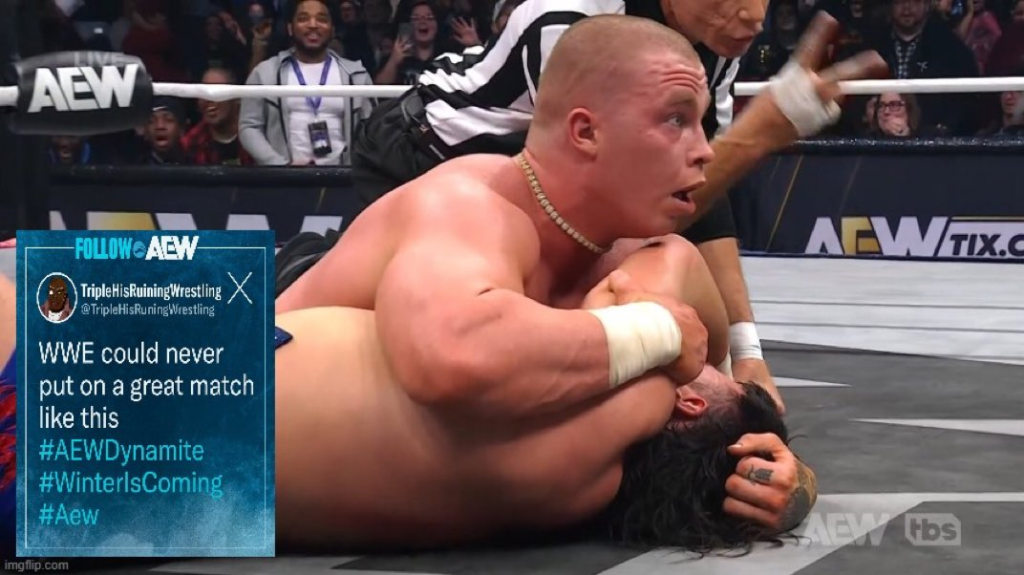
WWE, meanwhile, learned its lesson with WCW. In the 1990s, they weren’t above mentioning competition in a derogatory manner. The Millionaire Ted skits and the fake Razor Ramon/Diesel wrestlers are both great examples of this. What did WWE do to regain momentum? They shut the hell up about WCW and let their own talent show what they brought to the table. They showed fans in the Attitude Era what made the WWF product compelling to Generation X.
The lesson was this: You’re alienating your viewers who watch both programs. Leave that out of programming. Outside of it would be fine and fair. In fact, it’s being practiced. Aggregators, wrestling veterans, active talent, and fans in general do enough already, because they speak on a platform that should allow this type of discussion.
When it comes to the wrestling shows, let the wrestling speak for itself. Show why people should invest in your product, not stink up your own with pettiness toward another. That’s why in WWE’s big media days, whenever Paul Levesque, Vince McMahon, or Nick Khan threw dirt at AEW, Tony Khan’s response was to put on a great show. Not better, just great, and the type of wrestling fans expect from the promotion. I’d wager that to be why AEW’s rebound in 2025, continuing into 2026, has been well-received.
Regarding the fandom, however, tribalism has become a monster in its own right.
Recently, William Regal implored wrestlers to reduce the high-risk maneuvers in a now-deleted tweet. Nothing drastic, just taking care of one’s neck when bumping in the ring. For some reason, fans pointed fingers at WWE and AEW to the point where wrestlers had to speak up, such as AEW’s Kenny Omega, to defend Regal’s take. To my knowledge, Regal didn’t intentionally invite people to mud-slinging. From my perspective, he spoke from the heart to preserve future generations of wrestlers.
More recently, Shane “Hurricane” Helms, the wrestler-turned-producer in WWE, had to shut down a fan’s negative comment about AEW.
I wouldn’t be surprised if these wrestlers are frightened of their fans. This may sound cruel of me, but I’m certain that many of them would file restraining orders for some fans if they could. Let’s face it, some of the fans come across as Annie Wilkes from Stephen King’s “Misery.”
Now, that isn’t to say “just enjoy wrestling,” let alone all wrestling. That would be ridiculous, like if someone told me I had to eat food with onions on it. No. Absolutely not. I never want to eat onions. That pertains to someone who doesn’t want to watch AEW, WWE, NJPW, CMLL, Baka Gaijin…or whatever promotions are out there. Not everything will pique everybody’s interests. Do you know what you do when someone’s groaning about whatever product they don’t like? You move on. Block or mute if you have to. You don’t owe them your time or attention, nor any arguments.
To complicate things further, wrestling fandoms regularly see much infighting. Everyone has tastes as to what they like and dislike in pro wrestling. That’s fine and perfect. Wrestling is a variety show, one that caters to different people. Yet some aspects sit ill with fans, those of whom have a hard time admitting when something just isn’t for them. Then it becomes a war within the followers of a promotion. This is the case for fans of Cody Rhodes versus fans of Roman Reigns of WWE. Alternatively, AEW fans may bicker about personality overtaking in-ring ability, starting a back-and-forth that’s quite unnecessary when they could keep scrolling (if the discourse isn’t horribly toxic).
As the world continues turning, the presentation of promotions in 2026 has been influenced by current events. A harmless example would be NJPW positioning itself with a more pro-Japan attitude, opposed to the high Western presence.
But as for WWE and AEW, the dichotomy only grew. Both companies tout themselves as being an open place for talents of all walks of life to have their own opinions, but to fans, this looks to be demonstrably false. From my perspective, it’s mostly the former.
And that brings me to everyone’s favorite topic: morals.
WWE in 2025 soiled away its goodwill, thrust upon it after Vince McMahon’s removal from the company. Astronomically high ticket prices boxed out fans who could no longer afford it in today’s economy. Lazy booking dwindled the hype for most matches and angles. Brock Lesnar, named 44 times in the Janel Grant lawsuit, insulted sexual abuse survivors and those sympathetic to them. (Seriously, could it not have waited until after the lawsuit?) And lastly, the alliance with the Trump Administration further alienated or polarized its audience.
These have been common complaints I’ve seen from fans online and heard in person. As a result, this drives the conversation around tribalism. It’s so staggering that, ultimately, wrestling fans will have to reckon with WWE being on the unfavorable side of it until either the company and its culture change. Until then, former and non-WWE fans will have the mileage and higher ground.
These approaches by TKO and WWE aren’t reflected by their talent, with many only vaguely alluding to their real stances.
Considering WWE Hall of Famer and wrestling icon Mick Foley departed the company, with Simone Johnson (fka Ava Raine) following soon after, WWE talent have to make a choice. They could opt out of contract renewals or request their release. Alternatively, they could stick around WWE and try to make a difference, any difference, that aligns with their views, while partaking in something they don’t quite believe in.
With the reach WWE has, a superstar’s voice can make an impact. They may be limited, however, as seen in Ava Raine’s anti-ICE and Trump Administration tweet before deactivating her X account. Since she’s the daughter of Dwayne Johnson, star of the 2010 film Faster, she’s very well off. That’s not the case for other WWE stars. Granted, I don’t know these people, and I assuredly don’t know what they’re going through in their lives. I just know not everybody makes Roman Reigns’s level of income. These talents have to choose for themselves; I don’t have to.
I won’t pretend as though I’m better than anybody regarding tribalism. I consume wrestling as a part of media, whether I like what I’m watching or not. That’s being part of the media as a whole, engaging with the parts that leave one uncomfortable. Whether it’s boosting friends’ content in media, watching clips, or watching wrestling in general, I’ll inevitably run into something that challenges my beliefs and principles.
And to demonstrate that further, I’ll mention an elephant in the room. It’s only fair, right?
One of my favorite wrestlers, Hangman Adam Page, recently came under fire by AEW fans for featuring in a selfie with ostracized Marty Scurll. Page addressed the consequences of this selfie head-on, now aware that his decision to remain friends with Scurll will leave fans, predominantly female, to feel less comfortable. I don’t know Page personally, and I don’t envy being in his position. Nevertheless, I don’t agree with his decision.
As a wrestler and a character, Page has resonated with me. As a person, while I’m not personally affected, I’m disappointed. That goes the same for John Cena, another talent I’m fond of, who has unfortunately remained friends with Vince McMahon. That choice is their prerogative. My contempt lies more with the actual perpetrators of direct harmful actions.
The sad truth is, though, that no matter what promotion, mainstream or independent, the platforming of people like McMahon, Scurll, and Lesnar isn’t new, nor has it gone away. Allegations follow wrestlers from almost every promotion. It’s a curse, one that’s prevalent in the entertainment industry. Film, television, music, gaming, literature, adult films, YouTube, etc. It goes on and on. To consume and think otherwise would be folly.
If anyone is looking for a morally just wrestling promotion, they’ll have to dig deep. I mean deep. The rot is in so many places, despite the actions of others putting good in the world. And comparatively, fans are going to see WWE as the greater of the evils due to the sins they carry, though it will always, always be important to keep in mind that there’s no ethical consumption in pro wrestling. It’ll be in the littlest areas, whether anyone likes it or not.
That’s why, instead of justifying one company’s place over another, the most meaningful thing you can do is to do what you can. Watch whatever you feel makes you safe. Boost efforts to put genuine good in the world. And keep doing it. Even if nobody else sees it.
Be proud that your favorite thing is doing good and is agreeable to your tastes, but be prepared for disappointment. Humans are inherently flawed, and despite the greatness in our heroes, there still exist blemishes. Not everyone’s altruistic.
How a person approaches their viewing of pro wrestling is their choice. With the hostility of social media being what it is, everyone will ultimately experience someone sitting comfortably behind a screen, smugly defending their side while inhaling that dopamine rush that comes with being insulting or combative. Someone will vehemently protect their side and attack another as though they were personally employed by the company they’re riding hard for. At times, it’s as though wrestling is the whole world to fans, when there’s a plethora of joys in life to indulge in. Beyond the lens of pro wrestling lies a world requiring balance and investment.
Part of being a wrestling fan is to be wary of what is being said. Thinking critically, reading and listening comprehensively, and practicing media literacy. That’s an aspect of being a human being when understanding the world around us. Often, we humans operate on bias and hypocrisy. It’s in our very nature to act on it, denying otherwise as we might. Pro wrestling is a beautiful illusion drenched in compelling fiction, and the reality of situations within is designed to manipulate fans. It’s the core reason the medium has existed for over a century.
Tribalism, whether anybody likes it or not, will exist. I struggle with it myself, as my preferences teeter more towards AEW and NJPW. Naturally, fans will like one product over another. And that could always change. Equally, it’s reasonable to be critical and express what is and isn’t for a fan personally. But the way it’s wriggled around, I worry about people’s mental states. Online, people have demonstrated that they do not read beyond headlines and will read only into whatever justifies their biases. And once those biases are confirmed, it becomes a victory as though they themselves vanquished a great evil. But once betrayed, people have a hard time accepting a betrayal of trust, as if they’ve failed morally and have to escape that feeling.
When scoopsters and journalists reveal information, it’s a pick-and-choose situation when dissecting what’s true or not. One moment, someone will be washed and shouldn’t be trusted, and the next, it’s true because it’s the truth one wants. Not what is eventually disproven (or swerved, in some cases), but what one wants the facts to be. Wrestling fans indulge this mindset so much that they falter in comprehension of reality, often exposing how deep in the trenches of wrestling fandom they are.
Nobody has to enjoy a style or company of wrestling that they clearly don’t like. I’m not appealing for people to “enjoy wrestling” or stop their biases. I feel this space would be improved if people recognized their biases, went out of their comfort zones, and approached it with a sound mentality. To not attach identity to another person or entity. To just be you. Not the industry, not a company, not a wrestler. You. Just beautiful, old you. I know, that’s a bold thing to ask.
People are being abducted or murdered in the street. The infrastructure of the globe has been hinted at to have the most devious machinations behind it. Wealthy elites all over the world who influence our daily lives have done and are doing the worst things imaginable while affecting the very discourses we humans engage in. But that’s a topic for a different day.
For this reason, I also strongly encourage everyone to push beyond being solely interested in wrestling. So many wrestling fans are in so deep that they forget what’s truly out there. There’s more to the world. Art, music, cinema, nature, sport, romance, and life.
There’s an entire world outside of the squared circle, and it misses you.
