

Since 1933, Mexico has had the opportunity to have the privilege of being the home country of what is current day’s oldest wrestling company in the world: El Consejo Mundial de Lucha Libre (CMLL), guided by the vision of the man that is known as “El Padre de la Lucha Libre” (The Father of Lucha Libre), Salvador Lutteroth, who’s inspiration and memories are still remembered every year in La Catedral de la Lucha Libre in Arena Mexico with the known event Homenaje a Dos Leyendas.
Then, in 1992, during one of the biggest booms that the sport has ever seen in the country, former CMLL (Then EMLL) writter and booker, Antonio Peña, founded what would be known as Lucha Libre AAA WorldWide with his own vision, giving an alternative promotion for Mexico and bringing some talents with him on a road to create a new legacy that would be disliked by many individuals that felt it was a betrayal, but reality was different, it was an opportunity to share a beloved sport to even more people around the country.
Both companies would go on on a rivalry that would be both promotions on a gigantic clash. Bringing some of the most iconic luchadores to the show to see who could present the biggest shows and both companies would work evenly, bringing the likes of Mil Mascaras, El Canek, El Hijo del Santo, Eddy (Eddie) Guerrero, Blue Demon and Blue Demon Jr. But also creating icons, new characters to relate to people in the form of La Parka (A.K.A L.A Park), Rey Mysterio Jr, Psicosis, Atlantis, Ultimo Guerrero, El Felino, Negro Casas and many more. Lucha Libre was here to stay, not just be an ocassional sport, it was becoming part of Mexico’s culture, a way of living, an escape from reality that would be embraced on several environments.
The Big Jump to the United States
Jackie Joe, a luchador from Sonora was the first Mexican to wrestle in the United States in 1933, but it wasn’t until 1972 when Mil Mascaras made the first jump to a major company when he wrestled for WWE (Then WWWF) at a Madison Square Garden. Mil Mascaras would go on and challenge for the WWWF World Championship, Intercontinental Championship and the WWF Tag Team Championship along SD Jones. Then, thanks to the creation of AAA, the idea of being conservative, traditional and more with Lucha Libre started being an old idea with Antonio Peña saw some of the contracted luchadores to make a jump to American soil, regardless if he was agreeing to their decision or not, he was recognised as one of the principal people that brought Lucha Libre to the United States. Some of them worked at the 1997 Royal Rumble with Mil Mascaras himself, Cibernetico, Latin Lover and Pierroth Jr being participants of said match and then working on several promotions, but the most remarkable: Extreme Championship Wrestling (ECW) and World Championship Wrestling (WCW). Delivering us infamous moments such as the Mexican Death Match between Tajiri and Super Crazy, La Parka running around with his chair and being nicknamed “The Chairman”, Rey Mysterio and his legendary battles against Eddie Guerrero and Psicosis. All of this where the first steps for the American fans to explore on a new style of wrestling, a style that would also be more noticeable on WCW’s Cruiserweight Division and in matches that featured Luchadores part of the original Latino World Order (LWO). All the main elements and legacy would allow for several eras of Luchadores to participate in companies such as TNA, WWE and most recently, AEW.
More Than a Mask; An Identity
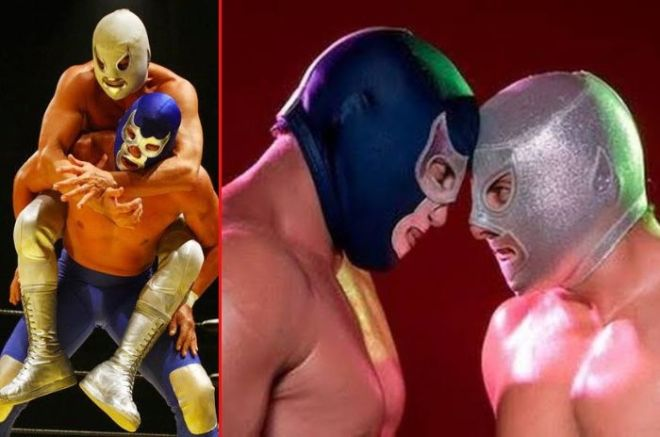
In Wrestling, a gimmick is usually the character that identifies your career for maybe a short period, maybe the rest of your career, but in Lucha Libre, it determines your life forever if you decide to persuade the dream of entering the four corners of survival. The most important figures of the industry that have left this world adopted a life that was tied with the mask, going beyond the sport, becoming icons and one with the name, with El Santo and Blue Demon being buried with their masks on and are character’s that have surpassed the industry itself, becoming an immortal part of not just Mexican Culture, but culture in general, as they where billed as real life superheroes that are still mentioned current day, being featured in movies, novelas, wrestling matches and more media that nobody has been able to surpass.
Americanization On The Industry
There’s no secret that Lucha Libre saw a decrease of the interest by fans and society around the 2006 all the way to 2008, key moments like the death of Antonio Peña, the insecurity in Mexico and the rise of popularity of WWE and MMA in the country started taking away the attention of the traditional methods. Lucha Libre started feeling it was rinse and repeat every time, until AAA started leaning towards a style that looked familiar, a style that could only be defined by “sports entertainment”, which made fans turn back to the company, only to realise they tried to be a bootleg version of WWE, even tried to bring bigger international names like AJ Styles, Bobby Roode or James Storm or doing angles too similar to what we could watch on the other side of the river with controversial endings such as the infamous L.A Park vs La Parka disaster when Los Perros Del Mal helped out L.A Park until the decision was reverted back, cause criticism to raise on the lack of creativity and essence that made the Mexican industries stand out, even reaching to a point that AAA was considered “a bootleg version of WWE with a cheap budget”, hurting the perspective of fans towards the company.
During the second half of 2024 and throughout 2025, it was clear that the popularity of Lucha Libre generated a modern boom, leading several stars to go viral thanks to highly acclaimed fights, Luchas de Apuestas that would represent a giant step in the careers of wrestlers such as Zandokan Jr. and Hechicero (to name a few), until these Mexican talents were incorporated more naturally into the two largest companies in the industry today: WWE and AEW, but not without notable consequences.
Despite everything, the attention that companies such as CMLL and AAA managed to attract from the general public outside the country has had consequences, including the participation of wrestlers who are not accustomed to the guidelines that are customary in the country, which has had a noticeable impact, especially since WWE purchased Lucha Libre AAA. Initially, the product changed gradually, with improvements such as better production and planning of spots, but also an even more noticeable departure from what was customary in Mexico, where, once again, the scarcity of Luchas de Apuestas caught the attention of fans, as this led to several already advanced storylines disappearing from the programming without a trace, being completely forgotten and trying to give a bigger importance to championships, which some fans would consider abnormal, as titles are mostly just decorations, rather than the highest price for companies.
Recently, another important detail was mentioned by several fans, where since the end of December 2024, it was noticed that every time a wrestler from AEW visited the Arena Mexico and the CMLL, the stipulations of the matches were changed to fit their customs. This was replicated during the “International Weekend,” where the scarcity of trios matches and 2 out of 3 fall matches was quite displeasing and received criticism, as the product began to lack personality, gradually becoming “AEW Dynamite Hours 3 and 4.” A couple of weeks ago, the CMLL announced that the Captain’s Rules for trios or tag matches would disappear completely, once again raising alarms among Spanish-speaking fans, who compared it to an American style and accused it of trying to be “colonized,” as many were labeling it.
Last week, during the most recent broadcast of Lucha Libre AAA, we saw how the long-standing rivalry between Abismo Negro Jr. and El Fiscal has been revived. Rumor said that this rivalry would be the main event at TripleMania XXXIII, where the two would battle it out to see who would carry on the name and mask of Abismo Negro. It was a fight that had been eagerly awaited for a long time and was one of those that had been forgotten. This has left a glimmer of hope that, perhaps, AAA management is realising that fans are not entirely happy with moving away from what sets them apart. The tradition of betting hair, names, and masks is something totally sacred, along with the rules of combat that have been followed for so many generations.
CMLL, on the other hand, does not seem to be backing down from its roots, as criticism continues to mount with each passing week, such as this week’s example with the Caballera vs. Cabellera match between Angel de Oro and Johnny Consejo (Johnny TV in AEW).
There is a fine line between supporting these alliances that have been reflected in the product and leaning entirely toward one side. It does us no good to have sold-out crowds week after week if things continue to feel empty, directionless, and above all, without heart and soul. Lucha Libre is a culture in Mexico, not just another sport and entertainment like in other countries. It represents our history, our real-life heroes, our escape from society to unite with others who share the same belief that without it, life would be flat and boring. Let’s not forget where we come from. Let’s embrace it and carry it forward because without it, we wouldn’t be where we are today after more than 90 years, bringing people’s eyes from outside your origin won’t pay off losing the people that’s always been there.
Want to discuss wrestling further? Join our Discord community by clicking here!
If you enjoy Bodyslam’s content, you can help donate to the site here. You can also visit our PWTees store and buy Bodyslam official merchandise here.
You can listen to all of Bodyslam’s podcasts by following us on Spotify and subscribing to our YouTube Channel, Twitch, Apple, Google, or any of your favorite podcast platforms.
Follow me on Twitter: @RiloOmega
Follow us on Twitter: @BodyslamNet
