
The Assassin’s Creed: Ikuro Kwon on Fatherhood, Legacy, and the Violent Path to MLW Gold

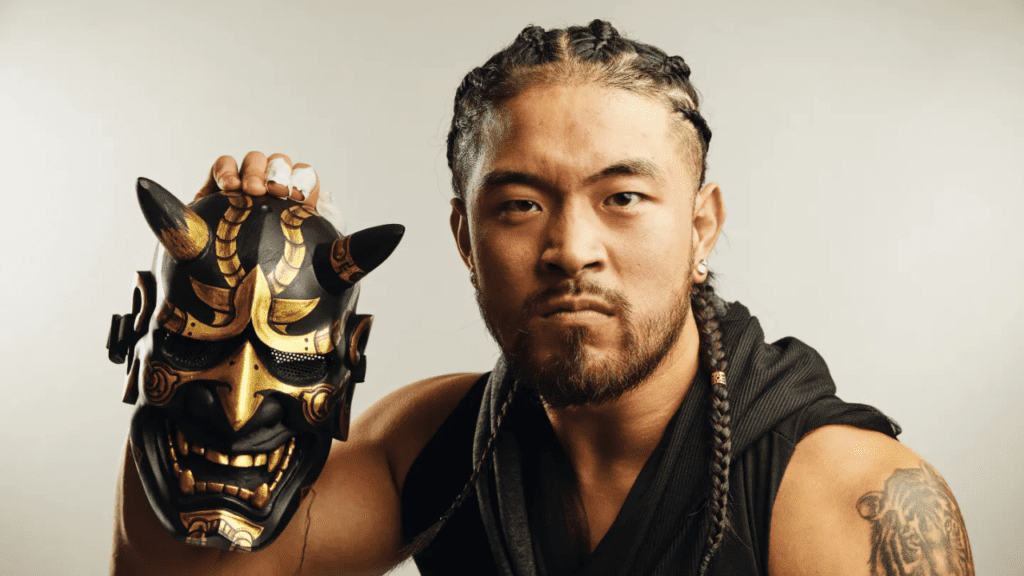
To understand Ikuro Kwon, you must understand the two sides of him. He is a ruthless fighter, shaped by the violent CONTRA Unit, yet also a proud new father. As a product of New York’s tough streets, he found his true calling in wrestling rings around the world. He is a man who uses violence in the ring to build a lasting legacy of hope and strength outside of it.
In a recent interview, Kwon shared the journey that brought him to this important moment in his career, revealing a complex character far beyond a simple tough guy.
From the Streets to CONTRA Unit
Ikuro Kwon’s brutal fighting style (a mix he describes as “martial arts training and street survival”) wasn’t forged in a gym, but on the hard streets of New York. Moving between Queens and Long Island, he has seen more funerals than graduations, facing knives, guns, and even being jumped by nine people at once. These experiences taught him that in a real fight, formal training means little—only survival matters.
This tough mindset is what caught the attention of the CONTRA Unit. They didn’t need to turn him into a weapon; he already was one. As Kwon bluntly put it, their goal was never to look good: “It’s not supposed to look pretty… I can make it look pretty if I want to, but I don’t want to.” He embodied their code of honor perfectly; a fighter from New York who understood survival at any cost.
“People say they can fight,” Kwon explained, “but usually, that means they fought their cousin in the backyard. They never had a knife pulled on them. They never had a gun in their face. They were never stomped out by nine people. I’ve been through all of that. So, I mixed disciplined training with pure survival. That’s my style.”
A Vacated Title and a Path of Pain
This survivalist mentality fuels his approach to the upcoming match for the vacant MLW World Middleweight Championship. Kwon believes the former champion, Mistico, vacated the belt specifically to avoid facing him. “Mistico says, ‘I’m gonna move up to heavyweight and I’m gonna vacate the title. I’m hurt.’ It’s like, no, you’re not hurt. You wrestled the next day,” he accused. “You’re going to vacate the title because you don’t want to lose it to me.”
In Kwon’s mind, the title was already his the moment it was abandoned. However, he must now defeat Templario to officially claim what he sees as his property. For Kwon, his infamous use of the poisonous mist—a tactic borrowed from legends like The Great Muta, Yoshihiro Tajiri and Asuka—is not a cheap trick, but a brutal message for anyone in his way, including Templario. “You’re in my way. I guarantee you won’t be in my way again,” he warned. “And if you are, I’m going to do more than temporarily blind you…I’m taking people’s faces. You think that I’m above that?…I don’t care. If you’re in my way, get out.”
He doesn’t view Templario as an enemy, but merely as the final obstacle. “For him, this is just another match. For me, it’s something deeper…and it’s going to get ugly,” Kwon promised. “What happens when he’s screaming for the referee, but the ref is knocked out next to him, and I still won’t let go [of the submission]?…It gets dark when I’m in the ring. He won’t be walking out with my title—because I won’t stop.”
Building a Legacy in MLW
Yet, Kwon’s story transcends mere survival and intimidation—it is fundamentally about purpose. MLW is not just a platform for violence; it is the stage where he is building a legacy rooted in resilience and unwavering determination. His journey from a scared, adopted child who never knew his parents to a championship contender proves one core belief: he always keeps his promises. “I always did what I said I would do,” Kwon stated. “Did I make mistakes? Absolutely. But I always kept moving forward for myself, my family, and my friends.”
He refuses to see his past as a burden. Instead, it fuels his mission. For his daughter, his fans, and the troubled youth he helps, he strives to prove that even the most difficult beginnings can lead to a meaningful life. Winning the vacant title is the validation of that struggle.
In his views, the championship symbolizes respect and a platform. “First, I’ll never let the title go,” he declared. “Second, I’ll use that platform… I want to defend it against everyone, everywhere.” But his true legacy extends beyond the ring. It is a legacy of guidance, built on the conviction that a passion that follows you from your dreams into your waking life is a compass pointing toward your purpose.
“If you love something, there’s a reason you wake up loving it,” he says, thinking of his daughter and everyone searching for their path. “Some dreams fade away—others stay with you. You have to figure out which is which. And I’ll be there for my daughter when she figures it out.”
Guided by this principle, Kwon’s real success is not measured in championships, but in being remembered as someone who guided others with honesty and strength. His ultimate goal is to serve as living proof that no matter how tough life gets, purpose and hope are always within reach.
